Operations
Why UK PPC agencies need named account owners before choosing tools
How UK PPC agencies should run paid search delivery: ownership, workflow, quality control, compliance and reporting, with a glossary and questions for account leads.
What to take away
- Decide who owns each account before you choose the tools the team uses. Ownership without a named person is the most common cause of missed spend and late reporting.
- Split delivery into three stagesbuild, run and review. Each stage ends with a written output, not a verbal handover.
- Treat compliance as a delivery task rather than a legal afterthought. UK advertising rules and electronic marketing rules both apply, and both are checkable.
- Report only on metrics the platform actually exposes.
How to structure PPC agency operations
The decision in front of most agency owners is simple to state and hard to make: grow by adding people to accounts, or tighten the process so fewer people carry more accounts? Operations is the answer to that question. It covers who does what, in what order, and what evidence exists that it was done.
Account assignment register fields
- Named lead and named cover
- Platform mix
- Monthly budget band
- Billing arrangement
- Next review date
- Monthly reviewfair share and handovers
Delivery model at ten vs forty accounts
Ten accounts
- Ownership
- clear
- Handovers
- documented
- Quality checks
- scheduled
- Break cause
- rare
Forty accounts
- Ownership
- unclear
- Handovers
- chat only
- Quality checks
- when remembered
- Break cause
- process, not skill
A delivery model that works at ten accounts usually breaks at forty. The break is rarely caused by media buying skill. It is caused by unclear ownership, handovers that exist only in chat, and quality checks that happen when someone remembers.
Ownership and account assignment
Every account should have one named lead and one named cover. The lead is accountable for performance and for the client relationship. The cover exists so that holiday, sickness and resignation do not leave an account unmanaged.
Write the assignment down in a single register. Include the platform mix, the monthly budget band, the billing arrangement and the next review date. A register is dull, but it removes the weekly argument about who was supposed to check a campaign.
Use a register with these columns:
| Account | Lead | Cover | Platforms | Monthly budget band | Billing | Next review |
|---|---|---|---|---|---|---|
| Example client | Lead initials | Cover initials | Google, Meta | £2k to £5k | Retainer | 2026-04-15 |
Before choosing tools, specify ownership requirements in the tool brief:
- named admin for each account
- how the tool records changes and by whom
- access levels that map to each role
- how the tool exports a dated change log
Ask suppliers to show a sample export. If the tool cannot name the person who changed a setting, it will not support your register.
Review the register monthly. Ask two questions: is anyone carrying more than their fair share, and has any account changed hands without a written note? Both problems get worse quietly.
Capacity is the constraint most agencies ignore. A lead who manages six accounts with heavy reporting will not also absorb a seventh without something slipping. The slip usually shows up as a missed negative keyword review or a late monthly report, not as a dramatic failure.
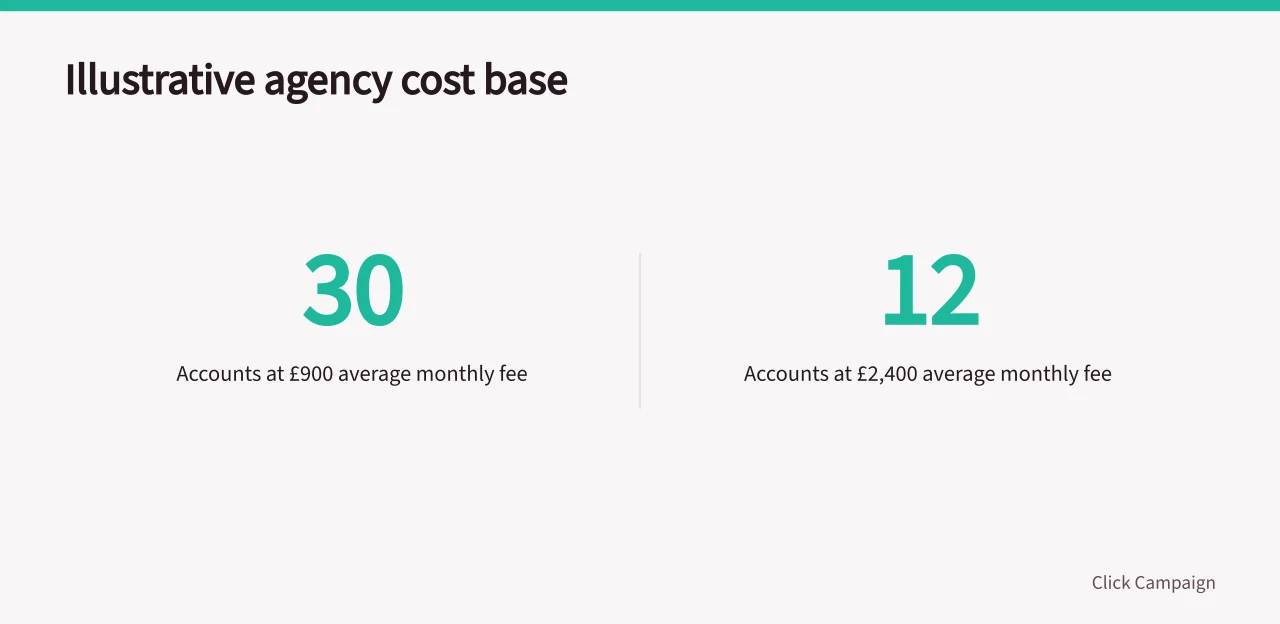
Illustrative arithmetic box (not benchmarks):
Accounts
- A
- 30
- B
- 12
Average monthly fee
- A
- £900
- B
- £2,400
Tooling cost per account
- A
- £80
- B
- £400
These figures are invented examples used only to show the arithmetic.
Onboarding deserves a fixed first-thirty-days list: access, tracking test, baseline report, naming convention and a plan the client has approved. Accounts that start without a baseline are impossible to review later.
Roles should be defined by output, not seniority. A paid search executive produces builds, checks and notes. A lead produces plans, client decisions and escalations. If two people produce the same output, one of them is not needed.
Escalation needs a route as well as a person. Define what counts as an escalation, who receives it, and how quickly a response is expected. Without that, junior staff either escalate everything or nothing.
Whether work sits in-house, with a specialist or with a contractor, the named lead remains accountable. Outsourcing a task does not outsource the client relationship.
Our guide to PPC agencies team roles: data and sources sets out which role owns which deliverable, which is the practical starting point if your register has names but no duties.
Workflow stages and handovers
Three stages cover most agency delivery. Build covers account structure, tracking and the first campaigns. Run covers daily and weekly management. Review covers reporting, forecasting and the next planning cycle.
Each stage ends with an artefact. Build ends with a tracking test and a structure note. Run ends with a weekly change log. Review ends with a report the client has actually read.
Naming conventions belong at the build stage. If campaigns, ad groups and audiences follow one pattern across platforms, reporting becomes a filter rather than a research project. Retrofitting names later costs more than setting them once.
Handovers fail when they are verbal. A change log that records what changed, when and why takes minutes to write and saves hours during a query. It also protects the agency when a client asks why a campaign paused on a Friday evening.
A completed line might read: 14 Mar 2026, 09:12, Account A, paused ad group Brand UK, budget pace at 82 per cent at mid-month, approved by JS.
Give each stage a gate. Nothing moves from build to run until tracking has been tested. Nothing moves from run to review until the change log is current. Gates sound bureaucratic, and in practice they stop the two failures that damage client trust most: unexplained spend and numbers that cannot be reproduced.
Client requests need their own route. A shared inbox with no owner produces duplicate work and missed replies. Decide who triages new requests, how long a response takes, and what counts as out of scope.
Change freezes are worth planning. Retail clients will not thank you for a structural rebuild in late November. Agree blackout periods in advance and write them into the workflow.
A short weekly team meeting keeps the register honest. Cover capacity, at-risk accounts and anything blocked. Fifteen minutes is usually enough if the change logs are already written.
The workflow itself, including suggested timings and checkpoints, is covered in our guide to PPC agencies operating workflow in England. Read it alongside this pillar if you are rebuilding the process from scratch.
Quality, compliance and the client relationship
Quality control in paid search is not a single review at month end. It is a set of checks placed where errors are cheapest to catch. Tracking faults, wrong budgets and missing exclusions are all cheaper to fix in the build stage than after a week of spend.
Alerts and audit cadence
- Account levelpacing alerts
- Conversion actiontracking alerts
- Weeklyanomaly review
- Monthlysample of accounts audited
- Quarterlyevery account examined once
Second-person build checklist
- Conversion tracking
- Budget caps
- Geo settings
- Negative keyword lists
- Record date and initials
Compliance sits next to quality because both rely on evidence. If you cannot show the check happened, assume it did not. Regulators and clients both work from records.
Checks, sign-off and evidence
Build a checklist that a second person can run. Include conversion tracking, budget caps, geo settings and negative keyword lists. Record the date and the initials of the person who ran it.
Google Ads campaign settings affect how ads are served, including budget and network choices, and Google documents how those settings interact with ad rank and cost per click in its campaign settings guidance. Use that page when you train juniors on which settings are safe to change and which need approval.
Automated alerts do not replace checks, but they buy time. Set pacing alerts at account level, tracking alerts on the conversion action, and a weekly anomaly review. Someone must own the alerts, or the inbox becomes noise.
Sample a proportion of accounts each month for a deeper audit. Rotate the sample so every account is examined at least once a quarter. Record what was found, what was fixed and how long the fix took.
Check message match between ad copy and landing page as part of the build gate. A strong ad that sends traffic to an unrelated page wastes spend and creates a poor experience for the searcher.
Sign-off should be tiered. A junior can approve a keyword addition. Budget changes above an agreed threshold, new campaigns and tracking edits should need a lead.
For example, set the lead approval threshold at any budget change above £500 a month or more than 20 per cent of the monthly budget, whichever is lower. An agency with a £2,000 monthly budget on one account would set the threshold at £400 and require lead approval for a proposed rise to £2,500.
Account access should follow the same logic. Give people the level they need for their role, review the list when someone leaves, and keep an owner for every admin account.
Keep an incident log for the failures that reach a client. One line per incident, with the cause, the fix and the change that prevents a repeat. Patterns in that log tell you where to spend training time.
Our PPC agencies quality checklist in England turns these checks into a runnable list, including the items most often skipped when a team is busy.
Advertising rules and data rules
UK advertising is regulated by the Advertising Standards Authority and the Committees of Advertising Practice. The ASA explains the split between the two bodies and how the rules are enforced on its page about advertising regulation. Paid search copy falls within that system, so claims in ads need the same care as claims on a landing page.
In practice that means keeping substantiation where a reviewer can find it. Price claims, comparative claims and availability claims all need evidence that predates the ad. Store that evidence next to the campaign.
Some sectors carry extra rules on top of the CAP Code. Check before writing copy for finance, health or alcohol clients, and ask the client for their compliance sign-off.
Tracking is a separate rulebook. Cookies and similar technologies used for measurement are governed in part by the Privacy and Electronic Communications Regulations 2003, published on legislation.gov.uk. Consent for non-essential tracking is not an optional extra, and agency teams should be able to describe what fires before consent and what waits.
Audit your tags when the site changes, not only at onboarding. A theme update or a new checkout can break a conversion action silently, and the report will simply show fewer conversions.
Agree where compliance records live and who can retrieve them. A record nobody can find within a few minutes is not much use during a complaint or a client audit.
Platform documentation matters too. Meta explains how its ad auction works, including how bids and quality signals interact, in its guide to ad auctions. That page is useful when a client asks why a cheap bid did not win the impression.
For paid social builds, LinkedIn publishes a step-by-step campaign creation guide covering objective, audience and format choices. Agencies running both search and social should align naming conventions across both, or reporting becomes a manual job.
Reporting, reviews and the year ahead
Reporting is where operations become visible to the client. A report that arrives late, or that quotes a number nobody can trace, undoes months of good delivery.
Reporting calendar essentials
- Agree metrics at engagement start
- Name the source and date
- Name the report sign-off person
- Keep metrics stable month to month
- Keep channel numbers beside blended
Set a reporting calendar at the start of the engagement. Agree the metrics and the person who signs the report off. Then keep it stable. Changing metrics every month makes trend analysis impossible.
Sourcing and dating figures
Name the source and the date for every figure you publish. If the number comes from the platform, say which platform and which date range. If it comes from an internal model, say so and show the assumptions.
Expect platforms to disagree. Attribution windows, modelled conversions and cross-device matching all cause gaps between a platform total and an analytics total. Pick one as the reporting source, state it, and explain the other rather than switching between them.
Where a figure is illustrative, label it.
Blended metrics deserve care. Cost per acquisition across all channels can hide a channel that is not paying its way. Keep channel-level numbers visible alongside any blended figure.
Keep the report format stable and the data latency honest. If numbers are three days behind, say so on the page rather than in a footnote. Clients forgive lag; they do not forgive surprises.
Our PPC agencies launch review: data and sources explains how to document sources so that a client, or a new account lead, can trace a number back to its origin.
Review, forecast and plan
Quarterly reviews should answer three questions: what changed, what it cost, and what happens next. Anything else is commentary. Keep the deck short and put the detail in an appendix.
Forecasting should be conservative and versioned. State the assumptions, the date and the owner. When the forecast changes, publish a new version rather than editing the old one, so the client can see what moved and why.
Capacity forecasting is the internal version of the same exercise. If three accounts are due to double their spend next quarter, work out the hours before you sign the contract. Hiring after the work arrives is the expensive way to grow.
Renewals sit at the review stage. Track what the client actually asked for against what the contract covers, and raise the gap early. Surprises at renewal are usually caused by silent scope creep rather than by performance.
The annual plan is where the quarterly reviews land. Pull the change log, the incident log and the forecast versions into one document, then set the targets for the year ahead.
Looking further out, our PPC agencies: trends and outlook for England in 2027 covers the shifts likely to affect delivery models, from automation in bidding to changes in how clients buy search work.
Glossary
- Account leadthe named person accountable for one client account.
- Buildthe stage covering structure, tracking and first campaigns.
- Change loga dated record of what was changed in an account and why.
- Change freezean agreed period when structural changes are paused.
- Coverthe named deputy for an account lead.
- Pacinghow spend tracks against budget over a period.
- Runongoing management of live campaigns.
- Reviewthe reporting and planning stage of the delivery cycle.
- Sign-off thresholdthe point at which a change needs a lead's approval.
Common questions
What does operations mean in a PPC agency?
It means the people, stages and checks that turn client work into delivered campaigns. It covers ownership, handovers, quality control and reporting. Media buying skill sits inside that structure, not outside it.
How many accounts should one paid search lead manage?
There is no universal number. It depends on budget size, platform mix, tooling and how much of the work is automated. Define the output expected from each role first, then set portfolio size to match.
Do UK advertising rules apply to paid search ads?
Yes. The ASA and CAP system covers UK advertising, and paid search copy is advertising. Claims need evidence, and comparisons need to be fair. Keep the substantiation on file.
What records should an agency keep for compliance?
At minimum, keep the tracking configuration, consent approach, change logs and sign-off records. These support client queries and any regulatory question.
In this guide
- When to redraw a PPC agencies operating workflow before handovers breakA practical guide to rebuilding a PPC agencies operating workflow in England, covering ownership, intake, QA and the handover evidence clients now ask for.
- how to build a PPC agency quality checklist with a visible audit trailA working quality checklist for England teams judging PPC agencies, covering ownership, landing pages, mobile performance and the evidence behind each claim.
- Which team roles do PPC agencies need for paid search delivery?A practical listicle on PPC agency team roles, with inclusion criteria, a decision table and the data sources that support delivery in the UK.
- Before you sign a PPC contract check the agency service standardsA practical guide to PPC agencies service standards in England, covering CAP Code duties, quality controls, response times and the evidence to see before signing.
- How to check PPC agencies launch review claims against sourcesA practical method for judging whether a PPC agency's launch claims rest on verifiable data or marketing copy, with a checklist on sources and consent.