Tools and providers
Part of A buyer's guide to PPC agency tools and providers
PPC agencies software selection explained for England teams
A practical guide to PPC agencies software selection in England, covering needs assessment, integration checks, cost comparisons and the questions to ask providers.
What to take away
Software selection is the process of matching a PPC agency's tooling needs to platforms delivering measurable campaign outcomes at a justifiable cost, starting with workflow gaps not the vendor list.
Check integration, data ownership and exit terms before price. Run a paid pilot on one account before an annual licence. Document who owns the data and what happens when the contract ends.
The wider PPC agencies: tools and supplier guide for 2027 sets out the full category map, so use it to shortlist tool types before you approach vendors.
Why does software selection start with your own workflow?
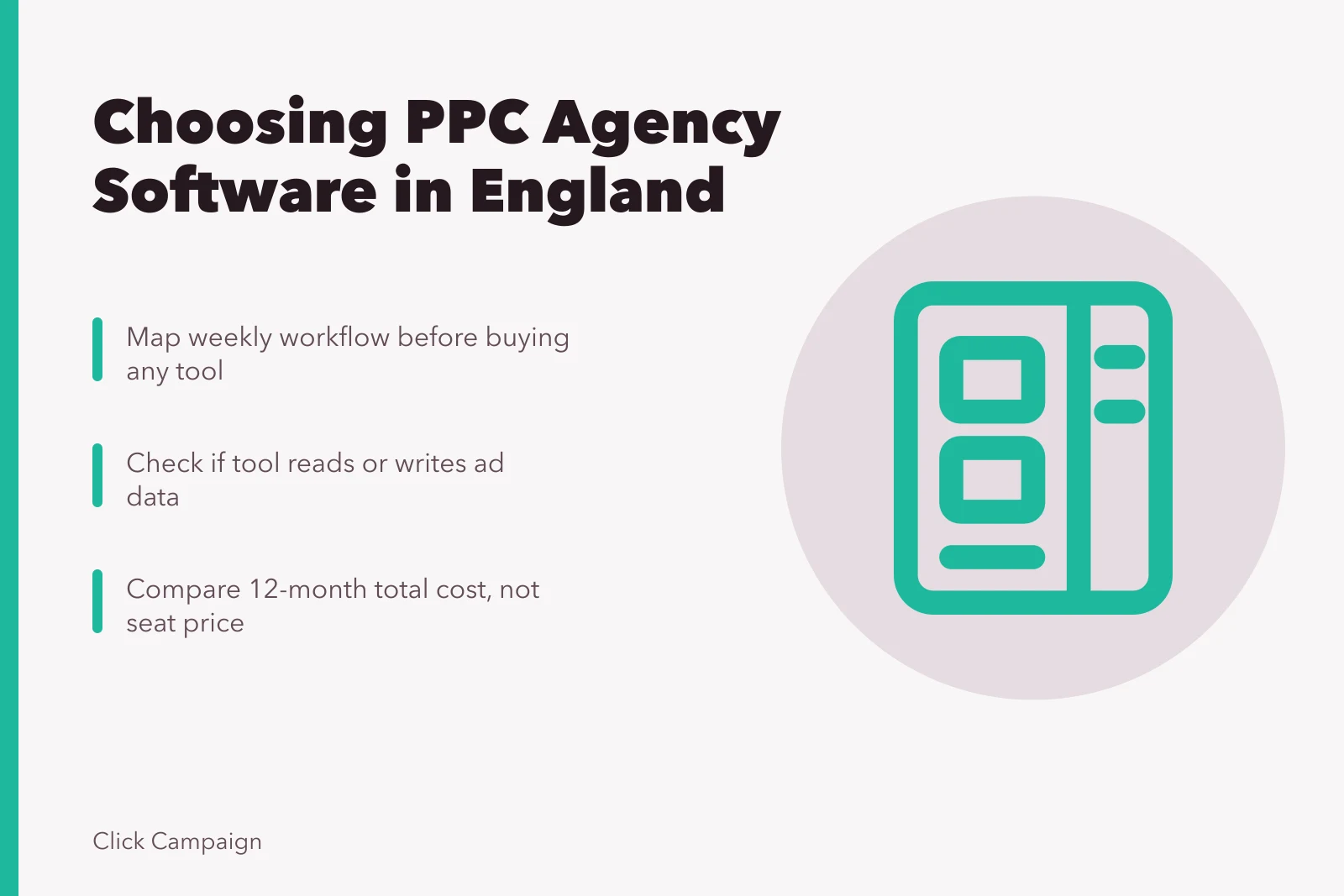
Most agencies buy tools to solve a problem they have not defined. Map the weekly workflow first: bid adjustments, budget pacing, negative keyword hygiene, reporting and client communication. Note where people spend time on manual steps.
Weekly Workflow Requirements Map
- Bid adjustments
- Budget pacing
- Negative keyword hygiene
- Reporting
- Client communication
- Mark manual steps and hours
- Rank essential or desirable
That map becomes your requirements list. A tool that automates bid changes but not reporting may leave the biggest gap untouched. Rank each requirement as essential or desirable, and put a rough hours figure against it.
If your team runs paid social alongside search, the self-serve LinkedIn Ads platform is a useful benchmark for what in-platform management can cover before you buy third-party software.
What should you check before signing a licence?
Integration depth matters more than feature count. Ask how the tool connects to Google Ads, Microsoft Advertising and analytics platforms, and whether it reads or writes data. Read-only dashboards rarely justify a premium.
Pre-Licence Integration Checks
- Connects to Google Ads
- Connects to Microsoft Advertising
- Connects to analytics platforms
- Reads or writes data
- Where account data is stored
- Who can export data
- Exit export format
Automation is the main reason agencies adopt API-level tooling. The Google Ads API documentation explains how programmatic access works, which helps you judge whether a vendor's claims are technically credible.
Data ownership is the next test. Confirm where account data is stored, who can export it, and what format you receive on exit. Poor exit terms create lock-in that outweighs any monthly saving.
How do you compare costs fairly?
Compare total cost over 12 months, not headline seat prices. Include onboarding, training, overage charges and the internal time to migrate. Ask for a written quote with every line item.
Compare costs fairly
Typical basis
- Licence
- Per seat or per account
- Onboarding
- One-off fee
- Usage
- Spend or API call tiers
- Support
- Tiered packages
- Exit
- Often unstated
What to confirm
- Licence
- Minimum term and uplift at renewal
- Onboarding
- Hours included and scope
- Usage
- Overage rate and caps
- Support
- Response times and channels
- Exit
- Export format and data deletion
For example, a team paying £400 a month per seat across six users faces a £28,800 annual licence before onboarding. That figure is illustrative, not a market rate.
Smaller advertisers with tighter budgets can lean on free guidance. The IAB UK SME Toolkit offers practical resources for teams running paid search without a large software stack.
Which questions expose weak providers?
Ask how the tool handles a sudden spend increase, a tracking outage and a client account transfer. Vague answers signal a shallow product.
Ask for two references from agencies of similar size. Then ask what those agencies stopped using the tool for, which reveals limits faster than a feature demo.
Before any contract goes to signature, run the checks in PPC agencies vendor due diligence in England so financial and security risks surface early.
Finally, ask about the roadmap. A provider that cannot describe the next two releases is unlikely to keep pace with platform changes.
Should you pilot before committing?
The pilot is the cheapest risk control available. Run the tool on one account for 30 to 60 days with agreed success measures: hours saved, error rate, or reporting turnaround.
Set a written exit point before the pilot starts. If the measures are not met, you walk away without penalty.
Pilots also reveal support quality. Log every response time and unresolved ticket, then weigh that against the sales promise.
Common questions
How long should software selection take?
For a single agency team, four to eight weeks is realistic: two weeks mapping needs, two weeks shortlisting, and the rest on demos, references and a pilot. Compressing this raises the chance of a poor fit.
Do we need separate tools for search and social?
Not always. Some suites cover both, but depth varies. If paid social is a minor channel, in-platform management may be enough and cheaper than a combined licence.
What is the biggest selection mistake?
Buying on feature demonstrations alone. Demos show what a tool can do, not how it performs on your accounts, with your data, under your reporting deadlines.
Who should sign off the final choice?
The people who will use the tool daily should test it, while finance and legal confirm the contract terms. A decision made only by leadership often misses workflow problems.