Operations
Part of Why UK PPC agencies need named account owners before choosing tools
When to redraw a PPC agencies operating workflow before handovers break
A practical guide to rebuilding a PPC agencies operating workflow in England, covering ownership, intake, QA and the handover evidence clients now ask for.
What to take away
- A workflow breaks once the same task has two owners, so name one accountable person per stage before adding tools.
- Intake, build, QA and handover need written entry and exit criteria, not verbal agreements between account managers.
- Platform-side changes to campaign setup steps and certification routes keep moving, so review the workflow each quarter.
- Handover packs should show the client what changed and why, with a dated audit trail.
- Small agencies can run the same structure as larger ones by keeping stages few and evidence visible.
Why the operating workflow needs a review now
Paid search delivery has become more procedural. Platform setup wizards, consent checks and client-side approval steps all sit inside the same fortnight. If your team still runs on memory, mistakes cluster around handover points.
A workflow is not a project plan. It is the repeatable route a task takes from request to signed-off result. When that route is unclear, clients see it as slow replies and unexplained changes.
The wider delivery model is set out in the PPC agencies operations and delivery guide, which is worth reading before you redraw your own stages.
Name one owner per stage
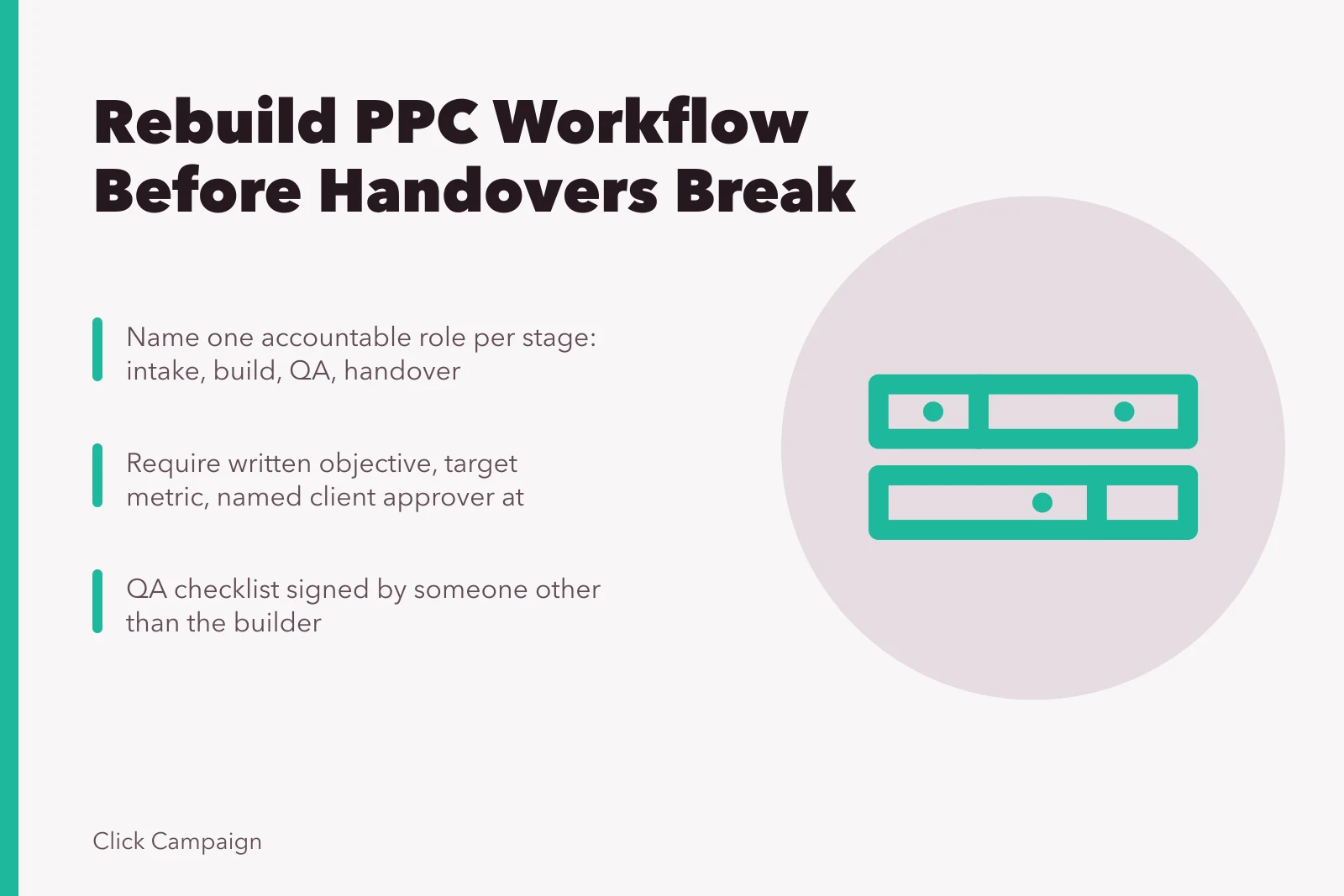
Every stage needs a single accountable role. Shared ownership sounds fair but hides delays. If two people can approve a budget shift, neither will.
Four stages, one owner each
- Intakewritten brief and named approver
- Buildcampaign assembled to spec
- QAsecond person signs checklist
- Handoverdated pack with change log
Write the owner next to the stage name on one page. Use roles, not names, so the document survives staff changes. A three-person agency might have four stages: intake, build, QA, handover.
For each stage, record the entry criteria and the exit criteria. Entry says what must exist before work starts. Exit says what proves the stage is finished.
Set intake rules that stop rework
Most rework starts at intake. A vague brief produces a campaign that has to be rebuilt. Require a written objective, a target metric and a named client approver.
Intake must-haves
- Written objective
- Target metric
- Named client approver
- One form only
Where a client asks for a new channel, the setup steps differ by platform. LinkedIn publishes a step-by-step route for creating a campaign in its guide to building your first LinkedIn campaign, which is useful when intake covers multiple networks.
Keep intake to one form. Extra fields slow clients down and rarely improve the brief.
Build and QA: keep the checks visible
QA should be a checklist someone signs, not a feeling. Cover tracking, targeting, budget caps, ad copy and landing page links.
The person who built the campaign should not be the only person who checks it. A second pair of eyes catches broken conversion tags and duplicated keywords.
Where staff need to prove their platform knowledge, certification routes exist. Meta runs professional certificate exams through its certification programme, and these sit alongside in-house training.
For skills beyond platforms, the digital marketing training courses from CIM cover the wider craft of paid search work.
Before and after: what changes in practice
Before and after
Before
- Ownership
- Shared across the team
- Intake
- Verbal or email request
- QA
- Informal review
- Handover
- Summary email
- Review
- Annual tidy-up
After
- Ownership
- One named role per stage
- Intake
- Single form with exit criteria
- QA
- Signed checklist by a second person
- Handover
- Dated pack with change log
- Review
- Quarterly workflow check
Handover evidence clients now expect
Handover is where trust is won or lost. Clients want to know what changed, when, and on whose instruction. A dated change log answers all three.
Keep the pack short. One page of changes, one page of results, and links to the live assets. Anything longer goes unread.
The evidence standards behind these packs are covered in the launch review notes on data and sources, which explains what counts as a reliable record.
Run a quarterly workflow check
Set a fixed date each quarter to walk the workflow end to end. Ask each stage owner two questions: what slowed you down, and what did you fix informally?
Informal fixes are the signal. If people are working around a step, the step is wrong. Update the document and tell the client what changed.
Keep the workflow to one page. If it needs more, the stages are too fine.
Common questions
How often should a PPC agency review its operating workflow?
Quarterly suits most teams, because platform setup steps and client approval habits shift within a year. A shorter cycle creates churn; a longer one lets workarounds harden.
Who should own quality assurance in a small agency?
Someone other than the person who built the campaign. In a three-person team, that may be the founder or a senior account manager who did not touch the build.
What belongs in a client handover pack?
A dated list of changes, the results those changes produced, and links to live assets. Add the name of the person who approved each change.
Can a workflow work across several platforms?
Yes, if intake and QA stay platform-neutral and only the build stage changes. Keep platform-specific steps in a short appendix rather than the main route.