Strategy
Part of What a written PPC agency plan means for UK advertisers
Why a PPC agencies strategy framework keeps paid search honest
How to build a PPC agencies strategy framework: objectives, budget splits, channel roles, a working checklist and answers to common planning questions.
What to take away
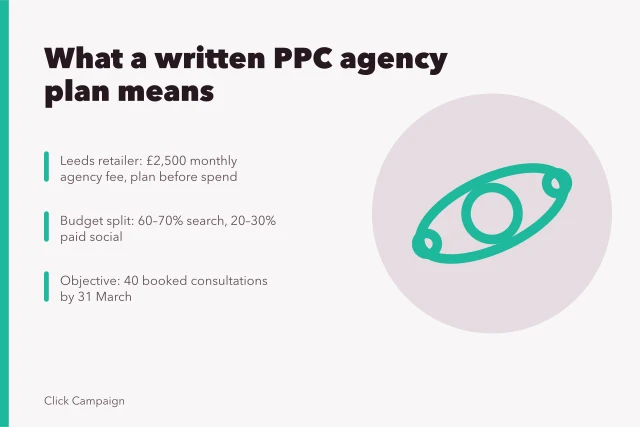
- A framework is a written set of decisionsobjective, budget split, channel roles, measurement rules and review dates. Without it, paid search drifts.
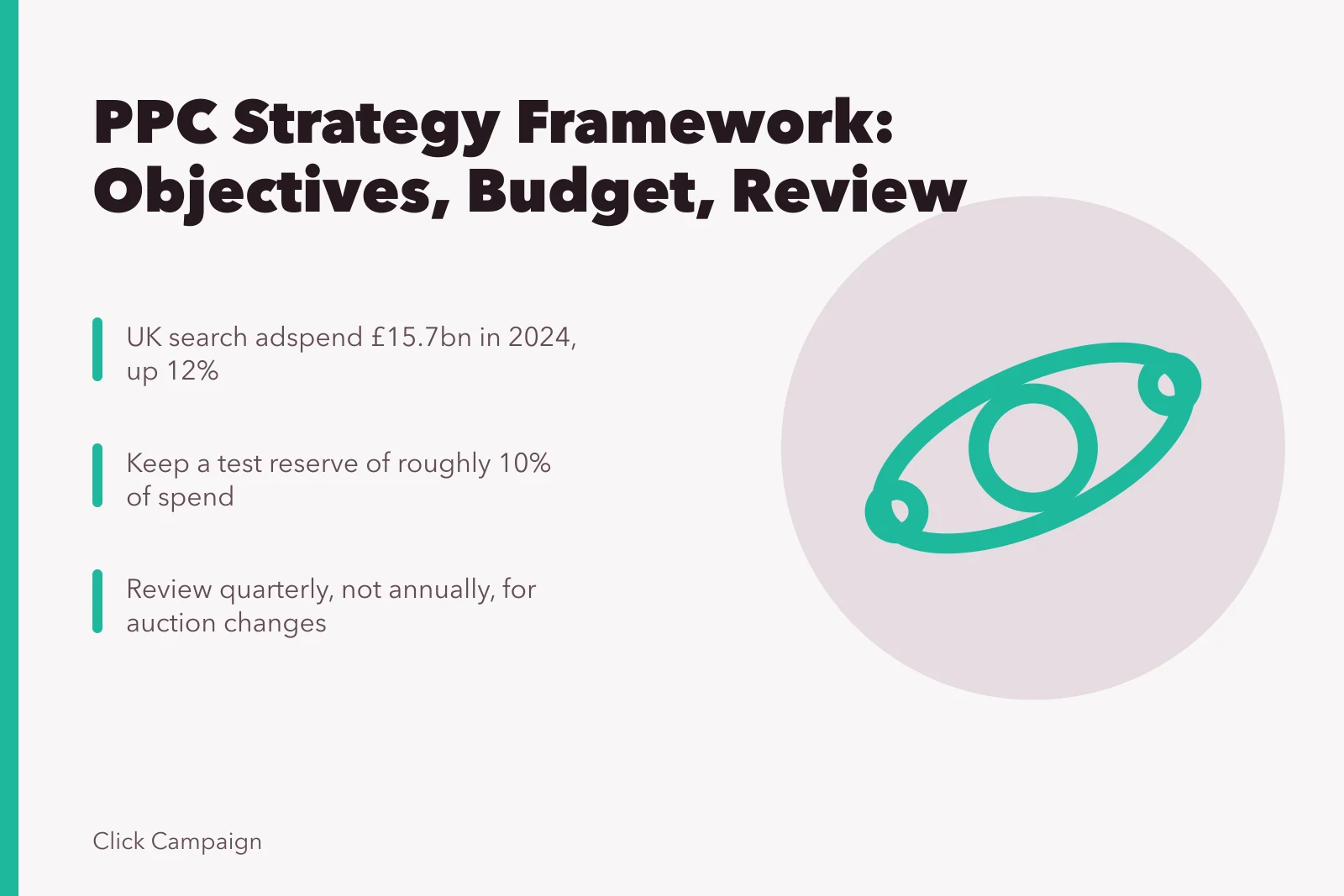
- IAB UK's 2024 adspend figures put UK search advertising at £15.7bn for the year, up 12% on 2023.
- Build the framework before you brief an agency. The objective decides the budget, and the budget decides the channel mix.
- The [PPC agenciesstrategy and planning guide for 2027](/ppc-agencies-strategy-and-planning-guide-for-2027) sets out the wider planning cycle.
Step 1: Fix the objective before the channel mix
Write one primary objective
Start with a single primary objective for the next 12 months, measurable and tied to a business outcome such as qualified leads, revenue or margin. Secondary objectives can exist, but they must not compete for the same budget.
Pick one primary objective
Primary objective: leads or margin?
Leads -> tolerate higher cost per lead
Margin -> exclude unprofitable segments
If the primary objective is lead volume, the framework tolerates a higher cost per lead. If it is margin, it must exclude unprofitable segments. Two primary objectives produce two competing plans.
Translate it into channel roles
Each channel gets a job. Brand search defends demand. Non-brand search captures intent. Paid social creates demand where search volume is thin. LinkedIn advertising suits considered B2B buying, so use the getting started guide for LinkedIn advertising when briefing a first campaign.
Write the role next to the channel in one line. If you cannot, the channel is not needed.
Step 2: Set the budget and data rules
Split the budget by evidence
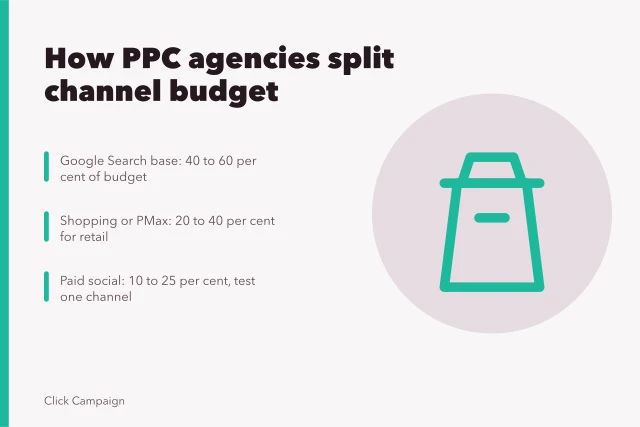
Start from last year's actual cost per acquisition by channel, not from a percentage rule of thumb. Allocate more to channels that convert within target and CAP the rest.
For example, on a £10,000 budget, if a channel's CPA is 20% above target, cut its budget by 10% and move that 10%, £1,000, to a channel whose CPA is at or below target.
Keep a test reserve of roughly 10% of spend, funding new keywords, audiences and creative without raiding proven campaigns.
The PPC agencies ninety day plan: data and sources shows which data feeds to pull before you set those numbers.
Agree the measurement rules
Decide what counts as a conversion, the window and who signs off changes. Use platform documentation for tracking rules and your own analytics for reconciliation. Small discrepancies are normal; document them.
Set a reporting rhythm: weekly pacing checks, monthly performance reviews, quarterly framework reviews. Name the person accountable for each.
Step 3: Brief and select an agency, then build the plan and checklist
Brief and select an agency
Ask for a written plan that names the primary objective, the budget split and the measurement rules. Check who will run the account day to day, not just who pitches.
Fee models vary: percentage of spend, fixed retainer or performance fee. Ask what determines the fee. Require access to the ad accounts and a clear exit period.
Shortlist two or three agencies, then test with a paid audit or small project before a long contract.
Turn the framework into a 90-day plan
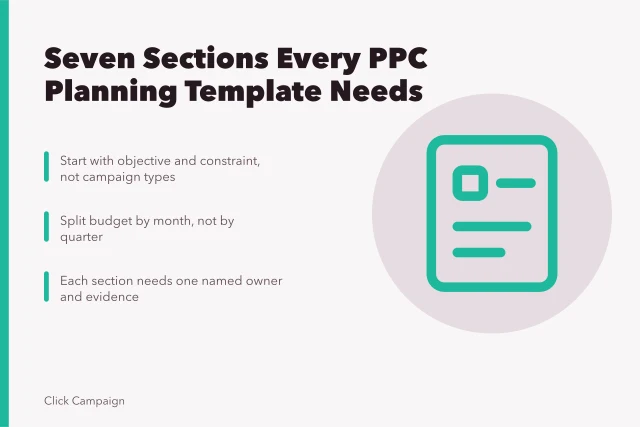
The framework is annual; the plan is quarterly. Break it into 90-day blocks with one or two priorities each. Every priority needs an owner, a budget line and a success measure.
Planning discipline matters here more than platform tricks. Formal training such as CIM strategy and planning training covers objective setting and the planning habits that transfer directly to paid search.
Keep creative standards explicit
Write down what good creative looks like before production starts. IAB UK publishes search advertising creative best practice covering relevance, clarity and format, a sensible baseline for any framework.
Framework checklist
- One primary objective, written down and dated (Step 1).
- A named owner for the framework and for each channel (Step 2).
- Budget split from last year's CPA, plus 10% test reserve (Step 2).
- One-line channel roles, including brand and non-brand (Step 1).
- Conversion definitions, windows and reconciliation (Step 2).
- A 90-day plan with two priorities per quarter (Step 3).
- Creative standards agreed before production (Step 3).
- Review dates in the calendarweekly, monthly, quarterly (Step 2).
Common questions
How long should a PPC agencies strategy framework last?
Set it for 12 months. The review cycle is in the framework.
Should the client or the agency own the framework?
The client owns the objective and budget. The agency owns the channel plan and execution. Write the split into the framework so decisions do not stall.
What if the objective changes mid-year?
Change it once, formally, and reset the budget split at the next review.
How many channels should a framework cover?
Only as many as you can fund properly. Two or three well-funded channels beat five starved ones.