Strategy
Part of What a written PPC agency plan means for UK advertisers
How PPC agencies channel strategy works explained
A comparison of how PPC agencies split budget between search, shopping and paid social, with questions to ask before you sign off a channel plan.
What to take away
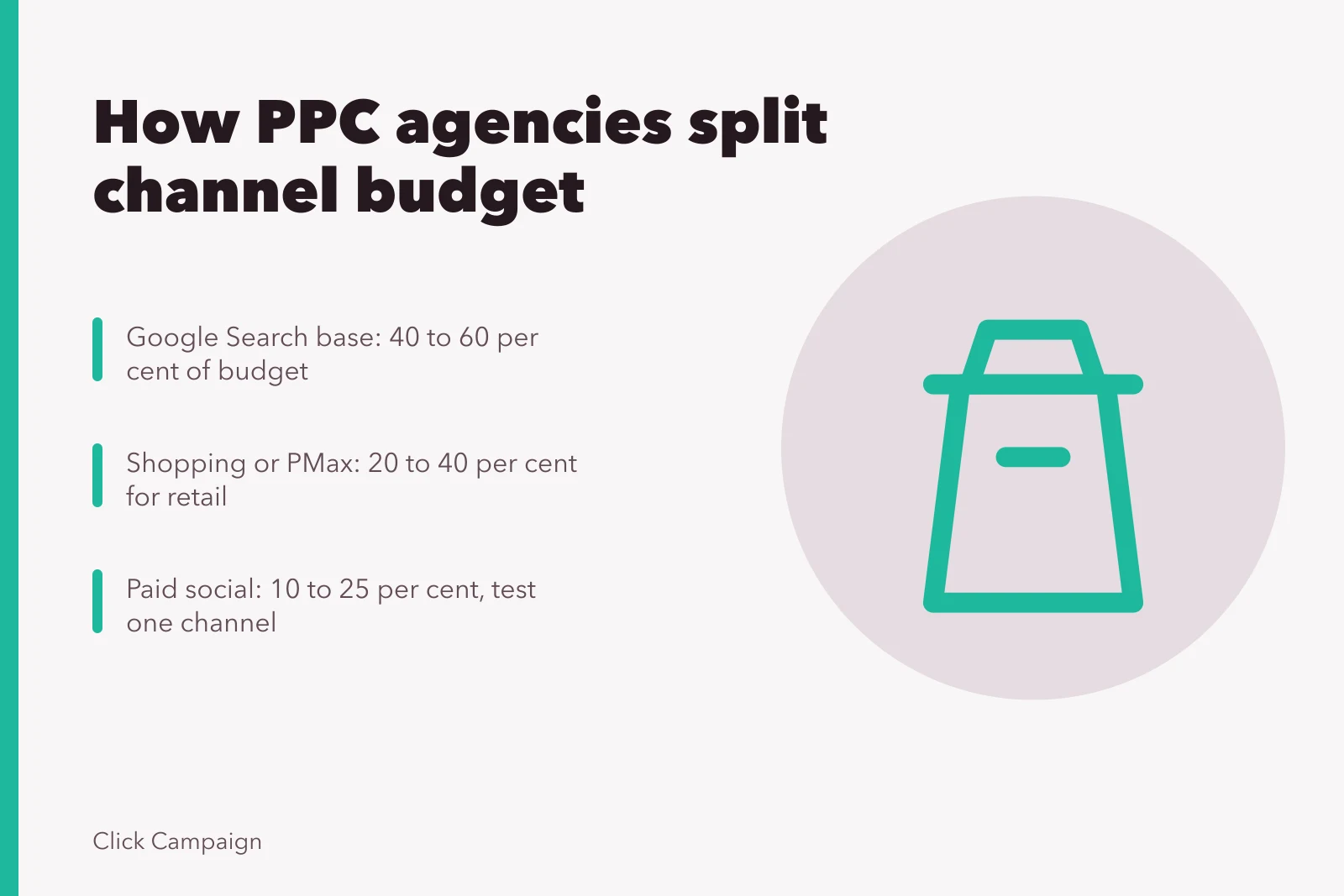
Channel strategy decides which paid channels an agency runs for you and how much budget each gets. Most England-based agencies now treat Google Search as the base, add Shopping or Performance Max for retail, then test one social channel.
Ask for a written split by channel, expected cost per acquisition and a review date. A channel plan without a stop rule is a wish list, not a strategy. Get the wider planning context in the PPC agencies: strategy and planning guide for 2027.
Which channels do PPC agencies normally run?
Search remains the default because intent is highest. A user types a query, sees an ad and clicks. Google publishes its own account standards in the Google Ads best practices guidance, which most agencies use as the baseline for structure, bidding and quality checks.
Shopping and Performance Max suit retailers with a product feed. They pull budget away from text ads, so the split matters. A feed with weak titles and images will underperform regardless of bid strategy.
Paid social sits outside search intent. LinkedIn Dynamic Ads, for example, build a creative from a member's profile photo and job details, as set out in the LinkedIn Dynamic Ads documentation. That is a demand-generation play, not a capture play.
Video is the fourth common line. IAB UK's digital video creative principles cover format and creative quality for paid video, which matters when a client wants awareness alongside search.
Search or social, which comes first?
Search first, in almost every case. It captures people already looking. Social creates the looking. Running social before you have a clean search account usually means paying twice for the same sale.
There are exceptions. A new brand with no search volume has little to capture, so social or video may lead for a quarter. A B2B firm selling a niche service may find search volume too thin to fill a budget, and LinkedIn or display does the heavy lifting.
The test is simple. If your branded search volume is close to zero, demand generation deserves a larger share. If you already rank well organically, paid search may only need to defend the top of the page.
How should budget be split between channels?
The table below is a comparison of typical patterns, not a rule. Figures are illustrative examples in pounds sterling.
Typical Channel Budget Split
Google Search
- Best suited to
- Lead gen, services
- Starting share
- 40 to 60%
- Main risk
- Rising CPCs
Shopping or PMax
- Best suited to
- Retail with feed
- Starting share
- 20 to 40%
- Main risk
- Feed quality
Paid social
- Best suited to
- B2B, new brands
- Starting share
- 10 to 25%
- Main risk
- Creative fatigue
Paid video
- Best suited to
- Awareness, launches
- Starting share
- 5 to 15%
- Main risk
- Hard to attribute
Budget split between channels
Best suited to
- Google Search
- Lead gen, services, branded defence
- Shopping or PMax
- Retail with a feed
- Paid social
- B2B, new brands, retargeting
- Paid video
- Awareness, launches
Typical starting share
- Google Search
- 40 to 60 per cent
- Shopping or PMax
- 20 to 40 per cent
- Paid social
- 10 to 25 per cent
- Paid video
- 5 to 15 per cent
Main risk
- Google Search
- Rising CPCs on head terms
- Shopping or PMax
- Feed quality, weak margin data
- Paid social
- Creative fatigue
- Paid video
- Hard to attribute
For example, a team paying £400 a month for search management might move £80 of that to social for one quarter, then judge the result. The split should follow evidence, not fashion.
The data you use to judge it matters as much as the split. The PPC agencies ninety day plan: data and sources sets out which internal and platform sources give a fair read on channel performance.
What should the agency prove before scaling a channel?
Proof Before Scaling a Channel
- Cost per acquisition by channel over four weeks
- Conversion definition matching sales or CRM data
- Stop ruleCPA level to pause the channel
Agencies that cannot show this are guessing. A channel that looks cheap on platform data may be expensive once you count leads that never convert. Channel comparisons need one definition of a conversion across the whole account.
Does channel mix differ across the UK?
Mostly no, because the ad platforms set one set of rules for the whole United Kingdom. Differences tend to come from the market, not the regulation. A London retailer faces different competition from one in a smaller city, and search volume varies by region.
Where rules do differ, they usually sit outside paid search. Advertising standards, data protection and sector rules apply across the UK, though some enforcement and licensing sits with devolved bodies in Scotland, Wales and Northern Ireland. Check the specific rule before assuming it applies everywhere.
Common questions
How many channels should a small business run?
Two or three is usually enough. Search plus one other channel, run properly, beats five channels run badly. Add a channel only when the current ones are stable and profitable.
Should paid search and paid social share one budget?
They can, but track them separately. Shared budgets hide which channel is working. Keep a single pot if you like, but report cost per acquisition by channel every month.
How often should the channel mix be reviewed?
Quarterly is a sensible rhythm for most accounts. Review sooner if a platform changes its bidding or targeting, or if your own margins move. Write the review date into the plan.
Can a PPC agency run channels outside search?
Many can, and some subcontract social or video to specialists. Ask who actually builds and optimises the campaigns. If it is a partner agency, you should know that before you sign.