Strategy
What a written PPC agency plan means for UK advertisers
How PPC agencies build a paid search strategy: objectives, budget splits, creative and measurement, with a numbered planning sequence for UK clients.
What to take away
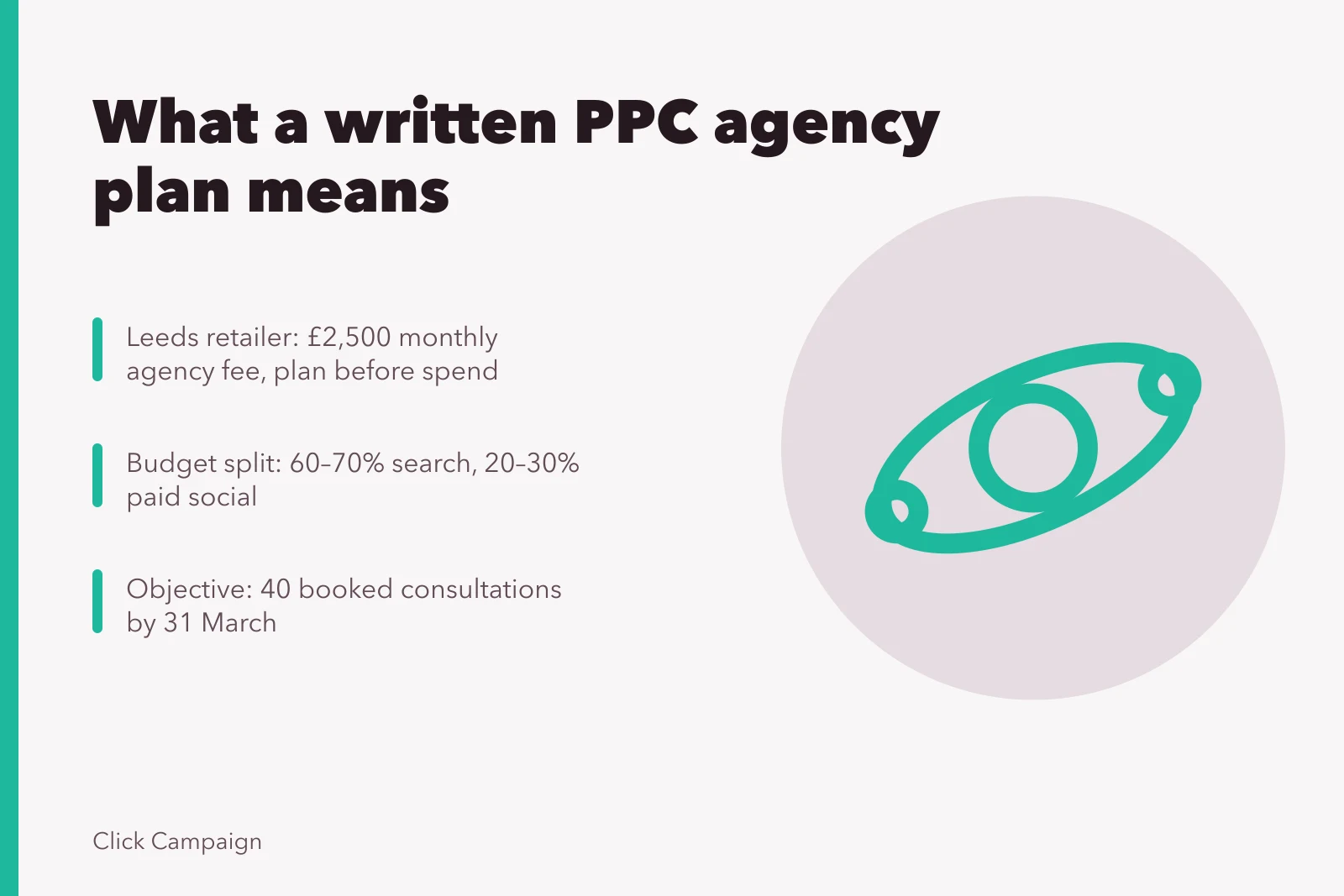
- A Leeds retailer paying an agency £2,500 a month should see the plan before the spend: objective, budget split, tracking and a review date, all written down.
- Strategy is a set of choices about where money goes and what is measured, not a list of channels.
- Every target should name the data source behind it, so the client can check it later.
- Consent rules and advertising codes decide which audiences an agency can actually buy, so compliance belongs in the plan.
- Book the next review date before launch.
Start with the commercial objective, not the channel
An agency that opens with a question about Google or Meta has skipped the useful part. The objective decides the channel. A service business chasing 30 qualified enquiries a month needs different buys from a retailer clearing seasonal stock.
Plan vs non-plan objective
Signed-off plan
- Objective
- 40 consultations by 31 March
- Capacity check
- 12 enquiries a week
- Reported metric
- Bookings
- Goal count
- One objective
Not a plan
- Objective
- Grow online presence
- Capacity check
- Unchecked
- Reported metric
- Clicks and impressions
- Goal count
- Five goals
Write the objective as a number and a date. Forty booked consultations by 31 March is a plan. Growing the online presence is not. The client signs off the number, and the agency owns the route to it.
A target also has to be possible. If the sales team can handle 12 enquiries a week, a plan that promises 40 is a plan for missed promises. Check capacity before anybody signs.
This is where many retainers go wrong. The agency reports clicks and impressions, because those are easy to pull from the platform. The client wanted bookings. The gap between the two is the strategy.
Agree what counts as a result and who can see the data before any media is bought. That single conversation removes most of the arguments that surface in month three.
One objective also beats five. Accounts with too many goals bid towards none of them.
Choose the channels against the objective
Channel choice follows the objective, the margin and the buying cycle. A high-margin B2B service can afford a longer path to purchase. A low-margin consumer product needs the sale to land quickly.
Channel fit by funnel stage
Paid search
- Funnel stage
- Bottom
- Best when
- Intent explicit
- Success measure
- Cost per lead
Paid social
- Funnel stage
- Demand gen
- Best when
- Offer visual
- Success measure
- Cost per qualified lead
- Funnel stage
- Job titles
- Best when
- Named companies
- Success measure
- Cost per qualified lead
Native
- Funnel stage
- Upper
- Best when
- Labelling matters
- Success measure
- Placement quality
Paid search usually carries the bottom of the funnel, because intent is explicit. Paid social carries demand generation, and works harder when the offer is visual or the audience is defined by interest rather than need.
LinkedIn suits named job titles and company sizes, and its own advertising guide sets out the formats and targeting available. Meta Blueprint, the free training from Meta, covers campaign structure and measurement for Facebook and Instagram.
Native and sponsored content sits further up the funnel. The IAB UK principles for native distribution are a sensible check on how that content is labelled and placed.
A clear split between channels, with a stated reason for each, is set out in this guide to channel strategy for paid search.
Each channel in the plan should carry its own success measure. Search might be judged on cost per lead and paid social on cost per qualified lead. One scorecard, different columns.
Budget splits should follow evidence rather than habit. If search converts at three times the rate of prospecting, the split should say so, and the plan should say when that assumption gets retested.
Set the budget and the split
Start with what the client can afford to lose while learning. Early spend buys information. A new account rarely performs at its best in month one.
Illustrative monthly budget split
- Search60 to 70 per cent
- Paid social20 to 30 per cent
- Tests and creativeremainder
A worked split in pounds is easier to check than a percentage. A local service account spending £1,500 a month might put £1,200 into search, £175 into paid social and £125 into testing.
A national brand spending £20,000 a month might put £13,000 into search, £5,000 into paid social and £2,000 into testing, with the agency fee on top.
Those figures are illustrative, not benchmarks. The right mix depends on the sector, the margin and how much search volume the account can absorb.
Agree the agency fee separately from media. Percentage-of-spend fees reward bigger budgets, which can pull against efficiency. A flat fee with a stated scope keeps the incentive cleaner.
Set a floor for testing. Even a tight budget needs a small pot for new keywords, audiences or creative, or the account stops improving.
Spread the budget across the month rather than concentrating it in week one. Steady pacing keeps learning even and avoids a spike that ends in a pause.
Build the measurement plan before launch
Tracking is the part clients notice last and miss most. If conversions are not recorded properly, the agency is optimising blind.
Measurement plan before launch
- List every conversion that matters
- Assign a value to each conversion
- State the reporting window
- Name and date each data source
- Feed offline conversions back
- Keep a simple scorecard
List every conversion that matters, then decide how each is counted. A phone call, a form, a booking and a download are different events with different values. Assign values so the platforms can bid towards the ones that pay.
Decide the reporting window too. A 30-day click window flatters some channels and hides others. State the window in the plan, so nobody changes it later to suit a result.
The data sources behind every target should be named and dated. A working method for recording them, including which platform figures to trust for what, is covered in this guide to a ninety day plan for PPC agencies.
Offline conversions matter for service businesses. A form fill that becomes a booked job three days later has to be fed back to the platform, or the bidding model learns from half the picture.
Keep a simple scorecard: spend, conversions, cost per conversion, and revenue where it exists. Everything else is context rather than a headline.
Handle consent and ad rules early
Audience targeting depends on lawful data. The ICO guide to individual rights explains what those rights mean for organisations holding customer lists.
Consent and ad rules checks
- Confirm lawful basis for list uploads
- Record what was consented to and when
- Check claims, prices and comparisons
- Name the approver, not the launch chaser
- Review devolved market rules
In practice this shapes list uploads, retargeting pools and lookalike audiences. If consent is unclear, the audience should not be built. Cleaning a list before upload is cheaper than defending it afterwards.
Keep a record of what was consented to and when. A permission collected years ago may not cover the audience an agency wants to build today.
Ad content has its own rules. The Advertising Standards Authority can act against misleading claims, and its published sanctions for non-compliance include requiring ads to be withdrawn and further action against repeat offenders.
Put a check in the workflow: who approves claims, prices and comparisons before they go live. That person should not be the same one chasing the launch date.
Rules differ across the UK. Gambling, alcohol and financial promotions carry extra conditions, and some of those rules are devolved. A campaign running in Scotland, Wales or Northern Ireland may need a different review from one running in England.
The planning sequence
Use this order. It keeps the plan tied to the objective and stops the channel debate from running the project.
Ten-step PPC planning sequence
- 1 Objective as number and date
- 2 Define and value conversions
- 3 Audit tracking, fix gaps
- 4 Map buying cycle, pick channels
- 5 Set budget, split, test pot
- 6 Confirm fee and scope in writing
- 7 Check consent and ad rules
- 8 Build structure, creative, landing pages
Steps 1 to 5: define, track and budget
Steps 1 to 5
- Write the objective as a number and a date, and get it signed off.
- Agree the definition of a conversion, and how each one is valued.
- Audit the tracking. Fix gaps before spending anything.
- Map the buying cycle and pick channels that fit it.
- Set the monthly budget, the channel split and the test pot.
The first five steps cost almost nothing to complete. Done properly, they take a fortnight and save several months of guesswork. They are also the steps agencies skip when they are eager to launch.
Steps 6 to 10: build, launch and review
Steps 6 to 10
- Confirm the agency fee and the scope in writing.
- Check consent, list permissions and ad rules for every market in the campaign.
- Build the account structurecampaigns, audiences, creative and landing pages.
- Launch small, with a cap on daily spend and a review date.
- Review at 30, 60 and 90 days against the scorecard.
Steps 6 to 8 are build work and can run in parallel. Step 9 is where discipline shows, because a small launch with a firm cap teaches more than a full-budget launch with no ceiling.
Writing the plan down
A plan that lives in one person's head cannot be reviewed. Keep it short enough to read in ten minutes and specific enough to check.
Fixed fields in the written plan
- Objective
- Audience
- Channels
- Budget
- Tracking
- Compliance
- Owners and dates
Use a template with fixed fields: objective, audience, channels, budget and tracking. Also include compliance, owners and dates. A worked version of that document is set out in this planning template for PPC agencies.
At minimum, a plan carries an objective with a number and a date, the conversion definitions, the channel split and budget, the tracking setup, the compliance checks, named owners, and review dates. Anything longer is supporting detail.
Each field needs one concrete line. This illustrative set shows the shape.
Field / Example line
- Objective
- 40 booked consultations by 31 March
- Audience
- Homeowners within 20 miles, drawn from a list with a dated consent record
- Channels
- Paid search for intent, paid social for demand
- Budget
- £1,500 media, £800 agency fee, £125 test pot
- Tracking
- Booked consultation, valued at £80, on a 30 day click window
- Compliance
- Consent checked and claims approved before launch
- Owners
- Client marketing lead and agency account lead
- Dates
- Launch 2 February, reviews at 30, 60 and 90 days
Name an owner for each line. The agency is not an owner. A named person on each side, with a weekly check-in, keeps decisions from stalling.
Send the finished plan to the client before the first invoice, not after the first report. Sign-off is what turns a proposal into a strategy.
Record the assumptions. If the plan assumes a 4 per cent conversion rate and the account delivers 2 per cent, the assumption is the first thing to revisit. That is a data conversation rather than a blame conversation.
Where plans commonly fail
Most failures are predictable.
Common plan failures
- Vague objective
- Broken tracking
- Channel chosen for fashion
- Budget cannot buy the volume
- Compliance treated as afterthought
- No named owner
A common failure is a channel chosen for fashion rather than fit. The client read about a platform and wanted it in the mix, and the plan bent around the request.
Budget is a frequent fault line. The client expects a level of volume that the budget cannot buy, and the agency avoids saying so at the pitch. Better to state the expected range up front.
Compliance gets missed when the plan treats it as an afterthought. Consent, claims and market rules belong at step 7, not in a complaint. The recurring failures seen in UK accounts are collected in this piece on PPC strategy mistakes in England.
A missing owner is the quietest failure of all. When two people each assume the other is watching the account, nobody is.
Reviewing and resetting
A plan is a set of bets, and bets need settling. Set review points at 30, 60 and 90 days, then quarterly after that.
Review and reset points
- 30 daysFirst review against scorecard
- 60 daysSecond review, one change
- 90 daysThird review, settle the bets
- Quarterly afterReset assumptions
At each review, answer three questions. Did we hit the objective? What did we learn that we did not know? What changes next?
Write the questions into the shared document, so both sides answer them before the call rather than during it.
Change one major variable at a time. Swapping budget, creative and audience together tells you nothing about which one worked.
Keep a short log of changes with dates. When results move, the log explains why. Without it, the account becomes a mystery that only one person can operate.
Retire the plan when the objective changes. A strategy written for a stock clearance should not govern the following year's brand work.
Planning for the year ahead
Budget cycles, platform features and buyer behaviour all shift. A plan written in the autumn for the following year should carry an assumption about what changes and when it gets checked.
Platform features change faster than budget cycles. Leave room for a mid-year reset rather than pretending the January version will hold to December.
The wider direction of the market, including the pressures likely to shape agency retainers and client expectations, is covered in this outlook on PPC trends for England in 2027.
Review the assumptions each quarter and write down what changed. An assumption with no review date becomes a belief.
Common questions
How long before a PPC strategy shows results?
Most accounts show a usable signal within 60 to 90 days, once tracking is clean and there is enough spend to learn from. Low-budget accounts take longer because data accumulates slowly. Set the first formal review at 90 days.
Should the agency fee be a percentage of media spend?
It can be, but a flat fee with a defined scope often aligns better, because percentage fees rise with budget rather than with results. Whichever model is used, state it in the plan and review it annually.
Who should own the ad accounts?
The client should own them. The agency works inside the client's accounts and business manager, with agreed access levels. That way the history, audiences and data stay with the business if the relationship ends.
In this guide
- Why a PPC agencies strategy framework keeps paid search honestHow to build a PPC agencies strategy framework: objectives, budget splits, channel roles, a working checklist and answers to common planning questions.
- Seven sections every PPC agencies planning template needsSeven sections for a PPC agencies planning template, from objective and budget to measurement and review, plus a numbered build order and the evidence to cite.
- How PPC agencies channel strategy works explainedA comparison of how PPC agencies split budget between search, shopping and paid social, with questions to ask before you sign off a channel plan.
- Six PPC agencies strategy mistakes that quietly drain English ad budgetsSix recurring PPC agencies strategy mistakes, from spend-led objectives to vague reporting, plus a scoring rubric for England advertisers comparing providers.
- When to start a PPC agencies ninety day plan and which data to gatherHow to build a PPC agencies ninety day plan around the right data sources, with a before and after table, Google Ads guidance and UK compliance checks.