Outlook
Why rising automation and ASA enforcement reshape PPC agency buying decisions
A guide to the PPC agencies outlook for England in 2027: what changes in search, how to set update triggers and how to compare providers without hype.
What to take away
- The decision in front of you is whether to keep, renegotiate or replace your paid search provider before the next budget year. That decision depends on how the PPC agencies outlook changes the work you are buying, not on a forecast number.
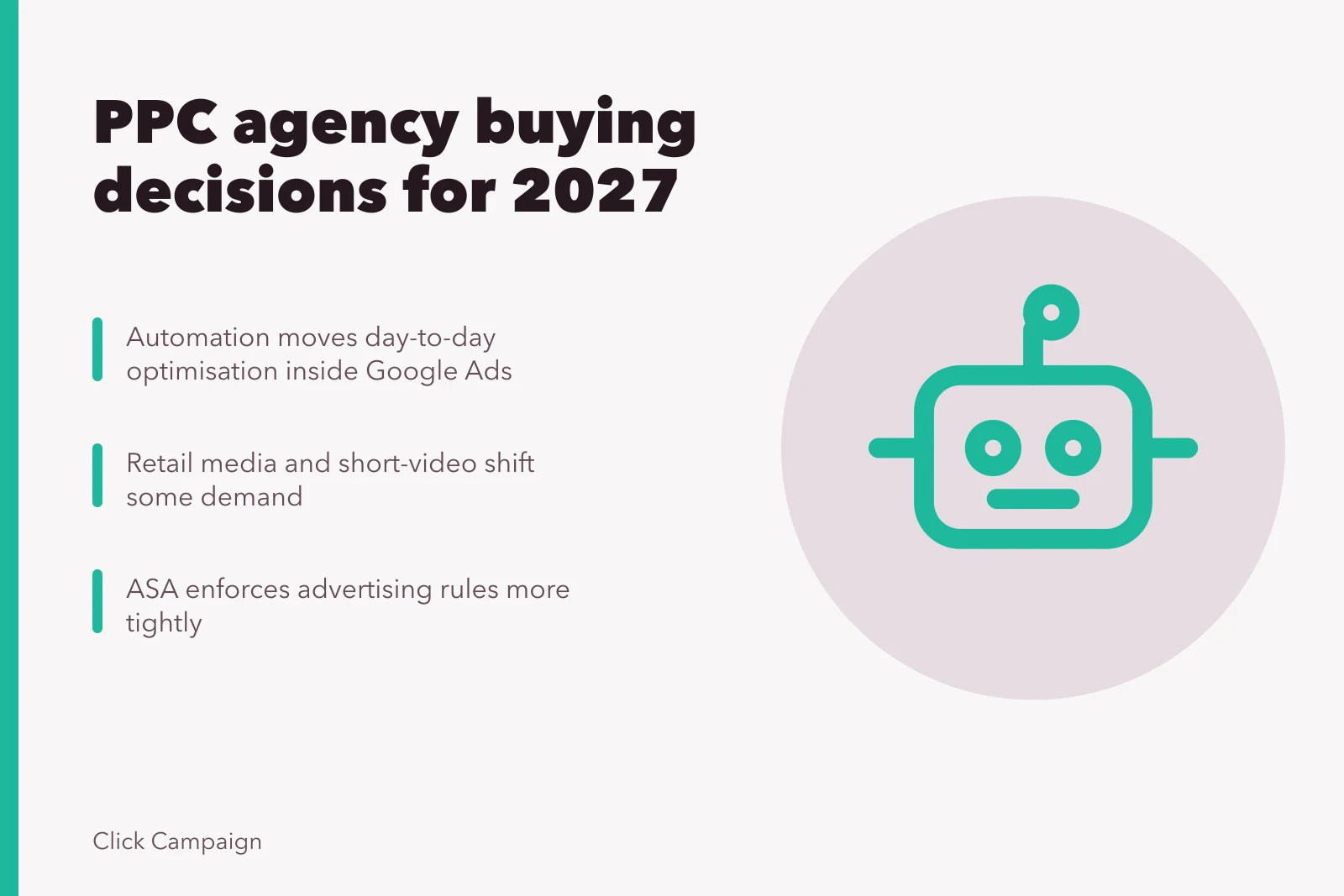
- Three forces matter most for Englandrising automation inside Google Ads, the shift of some demand to retail media and short-video placements, and tighter enforcement of advertising rules by the ASA.
- Set review triggers now. A trigger is a named event, such as a change in your cost per acquisition or a platform policy update, that forces a contract conversation.
- Judge providers on account structure, measurement and creative operations. Those three areas are where an agency can still add value once bidding is largely automated.
- Build a comparison method before you run a pitch, so you are testing the same things across every agency you speak to.
Why the outlook question is really a buying question
Most outlook articles answer a question nobody asked. They predict growth rates for a market and leave the reader with nothing to do on Monday.
If you run marketing for a business in England, the useful question is narrower: what will I be paying a PPC agency to do in 2027, and will that still be worth the fee?
Paid search management has moved from manual bid setting towards account governance. A person still decides what the account should achieve, how it is measured and what creative it runs. Software decides much of the placement and price. That split changes the skills you should be buying.
Our own PPC agencies market outlook: data and sources page collects the datasets worth tracking if you want to build your own view rather than borrow someone else's. Read it before you accept any growth figure in a pitch deck, including one from us.
One caveat applies throughout this guide. Rules differ across the UK. Advertising codes are enforced by the ASA across the whole of the UK, while some business support and tax treatment varies between England, Scotland, Wales and Northern Ireland. Check the position for your own trading entity.
The four changes that shape the PPC agencies outlook
1. Automation keeps moving up the account
Google Ads has spent years shifting control from keyword bids to automated bidding and broad matching. The practical effect for a client is that a large share of day-to-day optimisation happens inside the platform.
That does not remove the agency. It moves the work. Someone still has to define conversion actions, exclude bad traffic, structure campaigns so the automation has clean signals to learn from, and report honestly when performance moves. Poor conversion tracking now damages results faster than it did when a human could correct a bid.
Quality Score remains the clearest public signal of how Google assesses relevance between keyword, ad and landing page. The official explanation of Quality Score for Search campaigns is worth reading in full, because agencies often describe it loosely in pitches.
2. Demand spreads across more surfaces
Search is no longer the only source of paid clicks. Retail media networks, short-video placements and social lead forms all compete for the same budget line, and TikTok is now a standard part of the mix for consumer brands. Its TikTok Business Centre help pages explain campaign setup and optimisation inside the platform.
For a PPC agency, this creates a staffing question. A team that only knows search will either ignore these surfaces or buy them badly. A team that claims to cover everything may spread itself thin. Ask which surfaces the named account team has actually run, and for how long.
LinkedIn is the clearest example of a surface with a different logic. Its lead generation ads documentation explains an objective built around form fills rather than clicks to a website. If your business sells to other businesses, that objective may sit closer to your PPC goals than a search campaign does.
3. Creative becomes an operational discipline
Automated systems test more combinations than a human can review. That makes the supply of fresh creative the limiting factor in many accounts. Agencies that once treated ad copy as a one-off setup task now need a repeatable production process.
IAB UK publishes an introduction to creative best practice that covers the basics of digital ad creative, including how formats and placements affect what works. It is a sensible reference when you are agreeing what an agency will deliver each month.
Ask a simple question in any pitch: how many new ad variants will you produce per month, and who approves them? If the answer is vague, your account will run on stale creative by the second quarter.
4. Enforcement of advertising rules tightens
The ASA enforces the UK advertising codes, and its advice for businesses sets out what advertisers need to know about compliance. Paid search ads fall inside that scope, including claims made in ad text and on landing pages.
This matters more as automation generates more variants. A claim that was checked once can reappear in a new combination months later. Put a review step in the process, and make one named person responsible for claims that go live.
What this means for fees and contracts
Fee models have not changed as fast as the work. Many agencies still charge a percentage of ad spend, which rewards them for spending more rather than spending well. Others charge a flat retainer, which is predictable but can hide how much senior time you actually get.
PPC agency fee models compared
% of ad spend
- Rewards
- more spend
- Risk
- spend over results
- Senior time
- unclear
- Best for
- large spenders
Flat retainer
- Rewards
- predictability
- Risk
- hidden senior time
- Senior time
- hidden
- Best for
- stable needs
Scoped retainer
- Rewards
- defined scope
- Risk
- scope creep
- Senior time
- named lead
- Best for
- mid-sized advertisers
A workable compromise is a retainer tied to a defined scope: a set number of campaigns, a set number of creative variants, a set reporting rhythm and a named lead. Then agree a separate rate for project work such as a landing page rebuild.
Watch for the gap between the pitch team and the delivery team. It is common for senior people to attend the pitch and junior people to run the account. Ask who will be in your account weekly, and ask for that in the contract.
For a mid-sized advertiser, an illustrative example: a business spending £40,000 a month on ads might pay a retainer of £4,000 to £6,000 a month for management, plus production costs for creative. That is a labelled example, not a market rate. Your own numbers will depend on scope and sector.
How to set update triggers for the next year
A trigger is a written condition that forces a review. Without them, contracts roll over quietly and underperformance becomes a slow argument rather than a decision.
Set triggers in four areas:
Update triggers to write into contracts
- PerformanceCPA or ROAS movement on your analytics
- Platform changecampaign types, matching, policy
- Rulesadvertising codes or enforcement changes
- Commercialbudget, product range, target market
- Each trigger needs a number and a date
Write each trigger with a number and a date. "Review if cost per acquisition rises by more than 20 per cent over two consecutive months" is a trigger. "Review performance regularly" is not.
Our PPC agencies risk scenarios: data and sources article sets out the scenarios worth planning for, including the ones where the agency is not at fault but the account still suffers. Use it to stress-test your trigger list.
Comparing agencies without a beauty parade
Most pitches reward presentation. A structured comparison rewards evidence. Build a scorecard before you invite anyone, and score every agency on the same criteria.
Useful criteria include:
Agency scorecard criteria
- Account structure and campaign organisation
- Measurement and conversion tracking
- Creative operations and refresh cadence
- Teamnamed people and seniority
- Reporting that reconciles with your analytics
- Contractnotice, exit terms, asset ownership
Ownership deserves emphasis. Confirm in writing that ad accounts, conversion data and creative assets belong to you and transfer on exit. This single clause prevents most disputes.
Our guide to PPC agencies: reviews and comparison methods for 2027 explains how to run this process, including how to weight criteria when two agencies score closely.
Where AI fits, and where it does not
AI tools now write ad copy, suggest audiences and generate reports. Used well, they cut production time. Used badly, they produce plausible text that says nothing and variants that breach claims rules.
The sensible position for a buyer is to treat AI as capacity, not strategy. Ask an agency how AI changes what they deliver and how they check it. If the answer is only about speed, ask what the saved time is spent on.
Our PPC agencies AI applications: data and sources article covers the specific uses worth paying for and the ones that are mostly marketing. It also lists the sources behind the claims.
One practical test: ask to see a recent example of AI-assisted work and the human review that followed it. Redact the client name if needed. An agency that cannot show this is probably not doing it systematically.
Scenarios for the year ahead
Three scenarios are worth holding in mind. They are not forecasts, and none of them is certain.
Steady automation. Platforms keep improving automated bidding and creative generation at the current pace. Fees compress slightly as routine work shrinks, and the differentiator becomes measurement and creative volume. Agencies that built production processes do well.
Channel fragmentation. More budget moves to retail media and short-video surfaces. Search remains the anchor but no longer the whole plan. Agencies that only run search lose accounts to broader teams, and buyers need a way to compare spend across surfaces.
Tighter enforcement. Regulators pay closer attention to ad claims and to automated creative. Compliance work becomes a visible line item. Agencies that can evidence a review process win business from those that cannot.
In all three, the buyer's defence is the same: clear scope, named people, written triggers and ownership of assets.
A short glossary
- Paid search management.Running paid search campaigns on your behalf, including structure, bidding, creative and reporting.
- PPC agency.A supplier that manages paid advertising campaigns, usually across one or more platforms.
- Quality Score.Google's estimate of how relevant your keywords, ads and landing pages are to a user.
- Update trigger.A written condition that forces a contract or performance review.
- Retail media.Advertising sold by a retailer on its own properties, often alongside its product listings.
- Conversion action.The user behaviour you count as a result, such as a purchase or an enquiry.
Common questions
What is the PPC agencies outlook for England in 2027?
Expect more automation inside ad platforms, more budget shared with retail media and short-video surfaces, and closer attention to advertising rules. The outlook is best treated as a set of conditions to plan around, not a single growth figure.
Should I change agency before the next budget year?
Only if your triggers say so. If performance, reporting or team continuity has breached the conditions you agreed, run a structured comparison. If not, renegotiate scope and fees instead, which is usually faster and cheaper.
How should I compare PPC agencies?
Score every agency on the same written criteria: account structure, measurement, creative operations, named team, reporting and contract terms. Ask for evidence rather than examples of past wins, and confirm that accounts and assets belong to you.
What should I put in the contract?
A defined scope, named delivery people, a reporting rhythm, notice and exit terms, and a clause confirming you own the ad accounts and creative. Add your update triggers as a schedule so reviews happen automatically.
In this guide
- When to act on the PPC agencies 2027 trends shaping UK searchA source-led guide to five 2027 PPC trends in UK search, with a before and after table, named update triggers and UK agencies including Brainlabs and Croud.
- A platform API or a marketing qualification for PPC agencies AI applicationsWhere the data behind PPC agencies AI applications comes from, including Google Ads API documentation, CIM training and historic data protection law.
- Where can you find data on the PPC agencies market outlook?A source-led guide to PPC agencies market outlook data, showing which evidence to trust for England in 2027 and which claims to leave alone.
- Before you forecast PPC agencies skills, check where the numbers come fromA practical check on the evidence behind any PPC agencies skills forecast, covering ad experience standards, consent rules and where to raise market concerns.
- How to map PPC agencies risk scenarios using named data sourcesHow to pair PPC agencies risk scenarios with named data sources and observable update triggers, so each review happens before budgets are committed.