Foundations
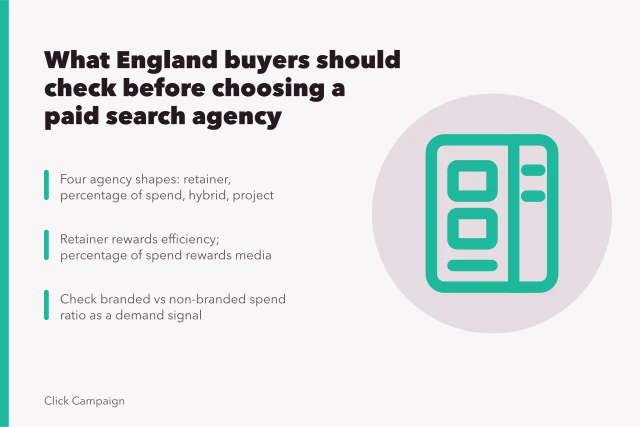
Part of What England buyers should check before choosing a paid search agency
Why PPC agencies business models shape what clients pay for
A comparison of the main PPC agency business models, covering how each earns money, who it suits and the trade-offs to weigh before you sign.
What to take away
- Four buying models cover most UK paid searchfixed retainer, percentage of spend, performance or hybrid, and in-house plus freelance. Partner-status resellers are a fifth variation.
- Fee basis matters more than headline price. Ask for a fixed fee, a percentage-of-spend band with a floor, or a commission per qualified lead, quoted in writing.
- Retainers leave delivery risk with you. Performance deals move some of it to the agency and add measurement risk at your end.
- Contract length and notice period set your exit cost. Read both before you compare fees.
- No model wins on price, risk and control at once. Decide which one you can trade.
The main PPC agency models side by side
PPC agency models side by side
Fee basis
- Fixed retainer
- Set monthly fee, tiered by spend or account count
- Percentage of spend
- Fee tracks ad spend, usually with a minimum floor
- Performance or hybrid
- Base fee plus target bonus, or commission per lead
- In-house plus freelance
- Day rate or project fee to a contractor
- Platform-partner reseller
- Managed fee plus platform arrangement
Who carries delivery risk
- Fixed retainer
- You
- Percentage of spend
- Shared
- Performance or hybrid
- Mostly the agency
- In-house plus freelance
- You
- Platform-partner reseller
- Shared
Check before signing
- Fixed retainer
- Notice period, scope changes, reporting cadence
- Percentage of spend
- Whether the floor is fixed and if the rate steps down as spend grows
- Performance or hybrid
- The written definition of a qualified lead
- In-house plus freelance
- Cover when the freelancer is unavailable
- Platform-partner reseller
- What partner status actually changes for your account
Each row answers a different question: how the agency is paid, who absorbs a bad month, and what you must confirm before signing. The fee column is commercial. The last column is contractual, and it is the one buyers skip.
Retainer tiers usually track spend bands, and our England market guide sets out what buyers in each band should check.
PPC agency models compared
Retainer
- Fee basis
- Fixed monthly
- Risk holder
- Client
- Best for
- Stable spend
- Main trade-off
- Quiet month costs same
Performance/hybrid
- Fee basis
- Share or bonus
- Risk holder
- Shared
- Best for
- Target-driven
- Main trade-off
- Attribution disputes
In-house + freelance
- Fee basis
- Freelance rate
- Risk holder
- Client
- Best for
- Existing specialist
- Main trade-off
- Hiring and cover risk
Where the risk sits in each model
A retainer agency is paid for effort and access rather than outcomes. Your invoice stays flat, and so does the risk you carry when a campaign stalls in a quiet quarter.
Percentage-of-spend fees rise with your budget. That aligns interests when more spend genuinely buys more conversions. It misaligns them when the extra budget only buys more clicks.
Performance and hybrid deals hand the agency an agreed share of the upside. They also make attribution arguments more likely, so the written lead definition decides who wins that argument.
In-house plus freelance support keeps control and data ownership inside your business. You take on hiring, holiday cover and the risk that one contractor moves on.
Freelance arrangements also lack a second pair of eyes. Our guide to auditing a PPC agency shows what a review should cover when one person runs everything.
Client-side model demands
In-house + freelance
- Control
- Client retains
- Data ownership
- Client
- Main risk
- Hiring and cover
- Suits
- Existing specialist
Platform-partner/reseller
- Control
- Shared with agency
- Data ownership
- Varies
- Main risk
- Status not results
- Suits
- Small advertisers
Partner status is a badge rather than a service level. Ask what it changes for your account before you let it influence the choice.
Example: the same brief priced three ways
Picture a Bristol retailer with a defined cost-per-acquisition target. It sends one brief to three agencies. The first quotes a flat monthly retainer covering strategy, build and reporting. The second quotes a lower base fee plus a share of tracked revenue. The third quotes commission per qualified lead with no base fee.
Compare them on total cost in your quietest month and your busiest, not on the headline rate. Then compare account ownership, data handover and notice.
Contract length, notice and exit cost
- Confirm whether notice runs from the invoice date or the month end.
- Confirm who owns the Google Ads account, the conversion tags and the historical data.
- Ask for the handover plan and how long support continues after notice.
- Check the agency's registered name and filing history at Companies House, using the Companies Act 2006 as your starting point.
- If you buy as a consumer rather than a business, the Consumer Rights Act 2015 sets the test for unfair terms.
Lock-in rarely hides in the fee. It sits in the notice period, the handover and the account ownership line.
How to choose between the models
- Write down your monthly ad spend floor and ceiling.
- Rank what you valuecost certainty, shared upside or control.
- Ask each agency to price your floor and your ceiling separately.
- Add your own oversight time to every quote before comparing totals.
- Read the exit clauses before you read the pitch deck.
Performance claims should be checkable against the ASA advertising codes, which govern what an agency can state in its own marketing.
Notice is where most model changes are won or lost. Our switching checklist sets out the handover order to work through.
Common questions
Which model is cheapest?
Freelance work and commission-only deals usually carry the lowest headline cost, because you fund less management overhead. The cheapest headline rarely stays cheapest once handover, oversight and rework are counted.
Where does risk sit in a performance deal?
Partly with the agency, which is paid only when the target is met. The rest sits with you, because a loose lead definition can turn a good month into a dispute.
Does Google partner status mean better results?
No. It can affect access to platform support and beta features. It does not change fees, contract terms or the team on your account.
Can I change model later?
Yes, and advertisers often move from retainer to hybrid once targets are proven. Notice is the constraint, so check exit terms before signing.