Foundations
What England buyers should check before choosing a paid search agency
A foundations guide for England buyers of paid search management: scope, agency business models, demand signals, due diligence and PPC planning for 2027.
What to take away
- Paid search management in England is a mature, crowded market, so the choice is not whether to hire a PPC agency but which operating model fits your budget rhythm and reporting needs.
- Scope is set by the platforms you advertise on and the outcomes you measure, not by the label on the agency's homepage.
- Expect to see a mix of retainer, percentage-of-spend and hybrid pricing, plus separate fees for creative, feeds and analytics work.
- Due diligence now includes checking a supplier's standing against advertising rules, not just asking for case studies and references.
- Budgets should be planned against platform costs, agency fees and measurement work as three separate lines.
Where paid search sits in the England advertising market
Paid search is the part of digital advertising where you bid for placements on search results and shopping surfaces. In England it is bought mostly through agencies, in-house teams or freelancers. The category is old enough that the terminology has settled: PPC agency, paid search management and performance marketing all describe overlapping work.
The market matters because it is where a large share of measurable demand is captured. Someone searching for a service has already expressed intent, and the auction prices that intent. That is why small changes in account structure, bidding or landing pages can move cost per acquisition more than a new channel launch would.
Scope is easier to define by platform than by sector. A paid search engagement might cover Google Search, Shopping and Performance Max, Microsoft Advertising, and increasingly retail media placements that behave like search. Amazon Ads sits in a grey zone: search-like in format, retail in data. Buyers should agree in writing which surfaces are in scope before comparing quotes.
The Office for National Statistics publishes data on the digital economy that helps frame how much of UK business activity now runs through online channels, which is the backdrop to paid search spending. You can review the digital economy statistics published by the ONS when you need an official anchor for market sizing rather than an agency's own deck.
Scope also has a regulatory edge. The Online Advertising Programme consultation set out the government's thinking on a stronger regulatory framework for online advertising, including paid search. Reading the Online Advertising Programme consultation on GOV.UK is worthwhile if you need to explain to a board why ad transparency and accountability are moving up the agenda.
How England agencies package paid search management
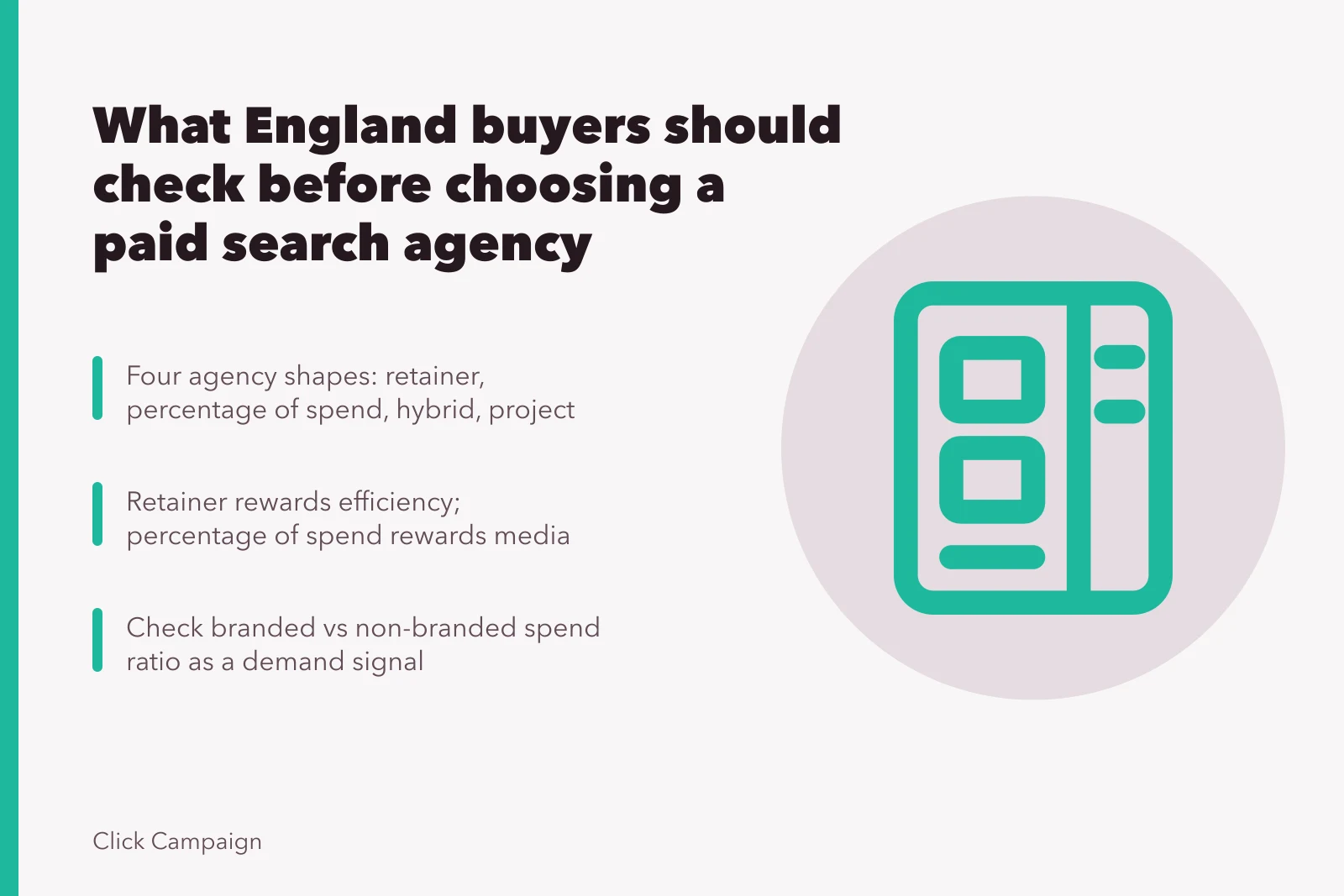
The packaging question comes before the pricing question. Most PPC agencies sell one of four shapes: a monthly retainer for a defined scope, a percentage of ad spend, a hybrid of the two, or a project fee for a defined piece of work. Each shape creates a different incentive.
Agency pricing models compared
Retainer
- Incentive
- Efficiency
- Cost control
- Strong
- Scaling
- Limited
- Best for
- Defined scope
Percentage of spend
- Incentive
- Media growth
- Cost control
- Weak
- Scaling
- Strong
- Best for
- Growing budgets
Hybrid
- Incentive
- Balanced
- Cost control
- Moderate
- Scaling
- Moderate
- Best for
- Mixed needs
A retainer rewards efficiency: the agency earns more if the account needs fewer hours. A percentage of spend rewards growth in media budget, which can be good for scaling but weak on cost control. Hybrid models try to balance the two by charging a base fee plus a smaller percentage.
Project work suits audits, migrations and Measurement setup. It is a poor fit for ongoing optimisation because nobody owns the account between projects. Many England buyers start with an audit, then move to a retainer once they have seen how the agency documents its decisions.
Whatever the shape, ask what is included. Common exclusions are feed management for Shopping, landing page builds, conversion tracking changes, creative production and analytics configuration. These are often where the real cost sits. Our guide to PPC agencies business models and their data sources breaks down how each model shows up in an agency's accounts and what to ask for.
Team structure matters as much as pricing shape. A senior strategist who appears only in the pitch is a warning sign.
Ask who runs the account day to day, how many other accounts that person holds, and what happens when they take leave. Small agencies can excel here: the person who pitched you does the work.
Market size and what the numbers can and cannot tell you
Market sizing for paid search in England is difficult because most spend passes through platforms that do not publish country-level breakdowns. Practical estimates combine three inputs: total UK digital ad spend, the search share of that spend, and the England share of UK business activity.
Illustrative total engagement cost
- £600,000annual media budget
- £72,000agency fees at 12%
- £15,000feed management
- £8,000tracking and reporting
The IAB UK is the trade body for digital advertising, and it has documented the growth of the industry it represents. Its account of the IAB UK's formation and role is useful context when you are trying to work out who publishes what and why different sources disagree.
Treat any single number with care. Agency reports tend to overstate the category they sell. Platform reports mix global and regional figures. Survey data depends on who answered. A defensible estimate names its sources, states the year and shows the arithmetic.
A mid-sized retailer in England has an annual paid search media budget of £600,000. At 12 per cent of spend, agency fees are £72,000 a year, or £6,000 a month.
Feed management adds £15,000, and tracking and reporting adds £8,000. The total engagement cost is £95,000 a year, about 15.8 per cent of media; the figures are illustrative, not market data.
At budget time, a buyer comparing only the percentage picks the cheapest-looking quote. Comparing total cost of ownership shows which agency is actually cheaper for the scope they need.
Our article on PPC agencies market size in England and where the data comes from sets out the sources worth citing in an internal business case.
Demand signals to watch before you brief an agency
Demand for paid search management moves with three things: how many advertisers are competing, how expensive the auctions are, and how confident finance teams feel about committing budget. None of these is visible in a single month of data.
Demand signals to track
- Branded vs non-branded spend ratio
- Seasonality peaks and agency capacity
- Platform policy changes
- Labour market and team stability
A practical signal is the ratio of branded to non-branded spend in your own account. If non-branded costs are rising while conversion rates hold, competition is intensifying. If branded costs rise, competitors are bidding on your name. Both change what you should ask an agency to do.
Another signal is seasonality. England retail, travel and education advertisers have pronounced peaks, and agency capacity tightens around them. If you brief an agency in October for a November launch, expect either a premium or a wait. Planning two quarters ahead is normal for larger accounts.
Platform policy changes are a third signal. When a major platform changes match types, reporting or consent requirements, accounts need work regardless of performance. Budget for compliance and migration, not just optimisation. Our breakdown of PPC agencies demand signals and the data behind them explains how to track these without relying on anecdote.
Finally, watch the labour market. Paid search skills are portable, and agency staff move between shops frequently. A stable team is a genuine commercial advantage, and it is reasonable to ask about tenure during procurement.
Due diligence: rules, registers and red flags
Due diligence on a PPC agency has three parts: who they are, what they have done, and whether they follow the rules. The first two are familiar. The third is increasingly important.
Due diligence checklist
- Check ASA non-compliant advertiser list
- Confirm entity at Companies House
- Ask named references about failures
- Verify conversion tracking and consent
- Ensure written data processing agreement
The Advertising Standards Authority publishes a list of non-compliant online advertisers, which is a useful check when a supplier also runs its own performance marketing. Reviewing the ASA list of non-compliant online advertisers takes minutes and can surface patterns you would rather know about before signing.
Company checks are equally quick. Confirm the registered entity at Companies House, check filing history and look for changes of name or address. A trading name that does not match the contracting entity is a common source of dispute when an account underperforms.
Ask for named references from clients of similar size and sector, and ask those references what went wrong as well as what went right. Agencies that cannot describe a difficult account honestly are usually poor at escalation.
On the technical side, ask how the agency handles conversion tracking, consent and data retention. Under UK GDPR, you are the controller for your customer data and the agency is a processor, so a written data processing agreement is not optional. Ask where data is stored and who can access it.
Red flags include guaranteed rankings or returns, reluctance to give you account ownership, reporting that shows impressions but not cost per acquisition, and contracts with long notice periods and no exit assistance. Any of these should prompt a harder look before you commit.
Working with an agency on LinkedIn and other paid surfaces
Search is rarely the only paid channel in an England media plan. Business-to-business advertisers often add LinkedIn, whose ad formats behave differently from search. Dynamic Ads, for example, personalise creative using profile data rather than keyword intent.
The LinkedIn Marketing Solutions documentation on Dynamic Ads explains the format if you are deciding whether to add it to an agency's scope.
When you add non-search channels, define who owns creative, targeting and reporting. An agency that runs search well may not have the same strength in social or programmatic. It is normal to split the account between specialists, provided someone owns the overall measurement plan.
Measurement is the hard part. Search attribution is relatively clean because the click and the conversion are usually linked. Social and display are messier. Agree a single source of truth, whether that is a platform-independent analytics setup or a marketing mix model, before you scale spend.
If you are comparing agencies on their ability to grow an account rather than just run it, read our analysis of PPC agencies commercial opportunities in England. It covers the areas where agencies can add margin without simply raising fees, which is a useful lens when you are negotiating scope.
Budgeting and contracts for 2027
Plan 2027 budgets in three lines: media, agency fees and measurement. Media costs are set by auctions you do not control. Agency fees are negotiable and should be tied to scope. Measurement is the line most often cut and most often regretted.
2027 budget example
- £250,000annual media spend
- £30,000agency fees at 12%
- £6,000reporting
- £4,000landing page work
For a worked example, an England professional services firm with £250,000 of annual media spend might pay £30,000 in agency fees at 12 per cent, plus £6,000 for reporting and £4,000 for landing page work. That is £40,000 on top of media, or 16 per cent of spend. Again, these are illustrative pound figures, not benchmarks.
Contracts should cover notice periods, exit assistance, account ownership and data portability. Thirty days' notice is common; ninety days is a warning. Ask what happens to the account on termination, and whether the agency will support a handover for a fee.
Expect platform change in 2027. Privacy rules, consent signals and AI-driven campaign types will keep shifting what works. A good agency will name the changes it expects and how it plans to respond. A poor one will promise that nothing will change.
Finally, revisit the scope annually. Paid search management in England is a competitive market, and pricing moves. A contract that made sense two years ago may not reflect what the work now involves. Our outlook piece, PPC agencies trends and outlook for England in 2027, covers the shifts worth building into next year's plan.
Common questions
What counts as a PPC agency in England?
Any supplier that manages paid search campaigns on your behalf, whether it is a full-service agency, a specialist search shop or a freelancer. The label matters less than the scope, the named team and the contract terms.
How are PPC agencies usually paid?
Most charge a monthly retainer, a percentage of ad spend, or a hybrid of the two. Project fees are common for audits and migrations. Ask what is excluded, because feed work, tracking and creative are often billed separately.
What should I check before signing with a PPC agency?
Confirm the contracting entity at Companies House, take references from similar clients, review the ASA's list of non-compliant online advertisers, and agree account ownership and data processing in writing.
Will paid search rules change in 2027?
The Online Advertising Programme consultation signalled a stronger regulatory framework for online advertising, including paid search. Final rules and timings are not settled, so treat 2027 budgets as planning assumptions rather than certainties.
In this guide
- How to read PPC agencies market size estimates for the UKNo official series reports the PPC agencies market size in England. Here is how the estimates are built, which sources count, and how to label a UK-wide total.
- Build a demand case for PPC agency services using eight public data signalsEight demand signals for PPC agency services in England, from IAB UK adspend data to Companies House filings, plus a worked example to size prospects.
- Why PPC agencies business models shape what clients pay forA comparison of the main PPC agency business models, covering how each earns money, who it suits and the trade-offs to weigh before you sign.
- Eight steps to build a PPC agencies market entry checklistA practical market entry checklist for PPC agencies in England, covering demand evidence, the eight setup steps, claims rules and first-90-day pricing.
- Commercial opportunities for PPC agencies explained for agency ownersPaid search work in England now spans audits, feeds and reporting. Here is how PPC agencies commercial opportunities differ by buyer type and format.