Strategy
Part of What a written PPC agency plan means for UK advertisers
Six PPC agencies strategy mistakes that quietly drain English ad budgets
Six recurring PPC agencies strategy mistakes, from spend-led objectives to vague reporting, plus a scoring rubric for England advertisers comparing providers.
What to take away
- The decision is not which agency looks best on a pitch deck, but which one plans around your margin and your measurement limits.
- Most failures start before a pound is spentspend targets dressed up as objectives, fixed budgets, thin reporting and no named owner.
- England-focused buying adds devolved advertising rules, UK GDPR duties and wide variation in agency pricing.
- Use the rubric below to compare providers on evidence, not presentation, and revisit it each quarter.
Mistake one: spend as the objective
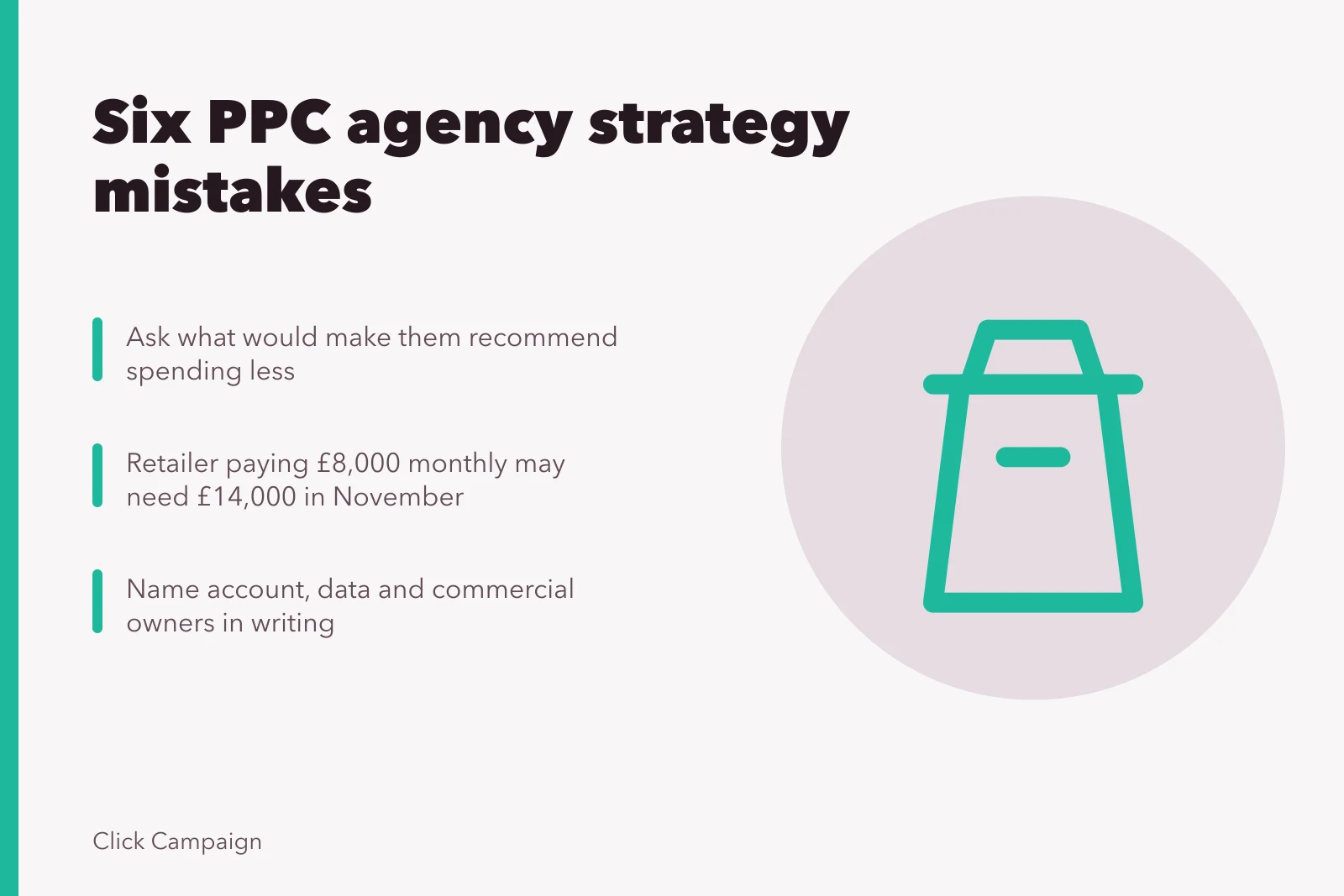
An agency that treats monthly spend as the goal will defend the budget rather than the return. Ask any contender what would make them recommend spending less. If they cannot answer, the incentive sits with the retainer, not your profit and loss.
A spend target also hides weak incremental returns, because the last pound rarely earns as much as the first.
The PPC agencies strategy and planning guide shows how objectives cascade from gross margin targets into channel decisions, which is worth reading before you brief anyone.
Mistake two: rigid annual budgets
Fixed annual budgets ignore seasonality, stock cycles and competitor activity. A retailer paying £8,000 a month, for example, may need £14,000 in November and £5,000 in February.
Ask how the agency flexes bids and budgets by week, and who signs off the shift. Quarterly reviews are too slow for a category where competitor bids move weekly.
Paid social has the same rhythm, which is why LinkedIn's guidance on boosting posts treats budget and creative refresh as ongoing decisions.
Mistake three: ignoring the delivery environment
Paid search rarely runs alone. Publisher-side ad blocking affects how many display, video and social impressions actually reach people.
The IAB UK consumer notice guide explains how publishers tell audiences about ad blocking, which matters when you plan reach across a mixed media schedule.
Ask which placements they would exclude, and how they would label impressions that never became viewable. An agency that never mentions delivery conditions is planning in a vacuum.
Mistake four: no named owner
Shared responsibility is no responsibility. A retainer needs one named person who owns the account, one who owns the data and one who owns the commercial relationship.
Ask for names, roles and escalation routes in writing. Where contractors or offshore teams are used, ask how quality is checked.
That is governance, not a reason to distrust smaller providers. A five-person agency can score well here, as long as the same lead attends every review.
Mistake five: reporting without decisions
A dashboard is not a strategy. Reports should end with a decision: shift budget, pause a campaign, change a landing page or renegotiate a target.
If the monthly pack contains no recommended action, you are paying for screenshots. Put the threshold in the contract so the review is a decision, not a debate.
Meta's free Blueprint training covers measurement fundamentals for paid social, and the same discipline applies to search: define the metric, the threshold and the action before the month starts.
Mistake six: planning without your data
Agencies that build plans from benchmarks alone will misjudge your conversion rates and lead quality.
A B2B advertiser with a 2% close rate, for example, needs different targets from an ecommerce brand converting at 3%.
The ninety day plan with data and sources shows how to assemble first-party evidence before committing to targets, which shortens the argument about whose numbers are right.
Bring conversion rates, lead quality scores and margin figures to the first workshop.
Scoring rubric
Score each provider from one to five on every row, then weight the rows to reflect your priorities. The rubric is for comparison, not for ranking agencies in the abstract.
PPC agency scoring rubric
Criterion
- Objective setting
- Ties targets to margin
- Budget flexibility
- Weekly reallocation with sign-off
- Delivery awareness
- Plans for ad blocking
- Named ownership
- One accountable lead
- Reporting decisions
- Every report ends with action
- Use of your data
- First-party evidence first
What good looks like
- Objective setting
- 20%
- Budget flexibility
- 15%
- Delivery awareness
- 10%
- Named ownership
- 15%
- Reporting decisions
- 20%
- Use of your data
- 20%
Weight
- Objective setting
- Budget flexibility
- Delivery awareness
- Named ownership
- Reporting decisions
- Use of your data
Weight the rows before you score, not after, and note the evidence behind each mark.
| Criterion | What good looks like | Weight |
|---|---|---|
| Objective setting | Ties targets to margin, not spend | 20% |
| Budget flexibility | Weekly or monthly reallocation with sign-off | 15% |
| Delivery awareness | Plans for ad blocking, viewability and placement | 10% |
| Named ownership | One accountable lead, escalation route in writing | 15% |
| Reporting decisions | Every report ends with an action | 20% |
| Use of your data | First-party evidence before target setting | 20% |
Common questions
Do these mistakes apply outside England?
Most are commercial rather than legal, so they travel across the UK. Where devolved matters are involved, check the relevant regulator before running a campaign in Scotland, Wales or Northern Ireland.
How quickly should an agency fix a strategy problem?
A named owner and a decision-led report can be in place within one monthly cycle. Budget flexibility and data-led target setting usually take a full quarter to bed in.
Should I change agency if the rubric scores are low?
Not automatically. A low score may reflect your brief rather than the provider. Fix the brief first, then rescore at the next review.
What evidence should a pitch include?
Ask for the objective-setting method, the reporting template and the escalation route. These three documents reveal more about strategy than any case study.