Operations
Part of Why UK PPC agencies need named account owners before choosing tools
How to check PPC agencies launch review claims against sources
A practical method for judging whether a PPC agency's launch claims rest on verifiable data or marketing copy, with a checklist on sources and consent.
What to take away
A PPC agencies launch review is an assessment of the evidence an agency publishes when it launches or relaunches a paid search service. Below is a worked method for judging that evidence, not a scorecard of named firms.
- Separate vendor claims from independent evidence before you score anything.
- Check the source behind every number, and the date it was published.
- Test measurement claims against ICO guidance on online tracking, which covers cookies and pixels.
- Confirm ad copy and landing page wording against the ASA Copy Advice service.
- Score what the agency can evidence, and record what you could not verify.
This is a desk review of published material. No agency was interviewed, no account was audited and no platform access was used.
Scope of the review
We assessed launch announcements, case study pages, service descriptions, pricing notes and any named sources. We did not assess account performance, staff credentials or contract terms, none of which a public page can confirm.
For each figure we checked whether the source is named, dated and public. Marketing context from bodies such as CIM articles and reports can frame a sector claim, but it proves no specific agency result.
Separating claims from evidence
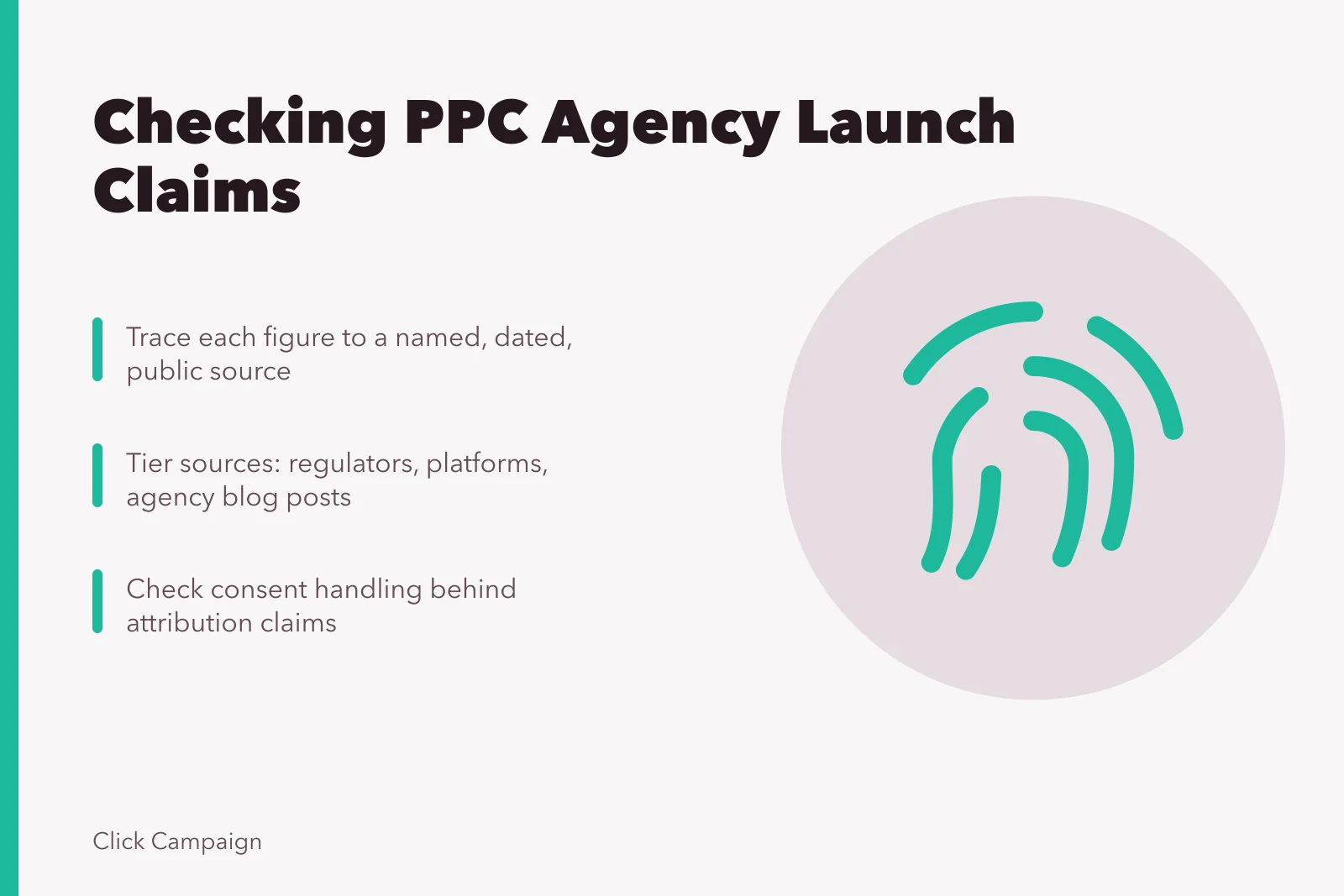
Treat every figure on a launch page as a vendor claim until you can trace it. A claim becomes evidence when three things line up: a named source, a date, and a method you could repeat.
Claim vs Evidence
Vendor claim
- Source
- None named
- Date
- Undated
- Method
- Not stated
- Example
- CPL fell 38%
Evidence
- Source
- Named source
- Date
- Dated
- Method
- Repeatable method
- Example
- 12 accounts, Jan-Jun 2026
For example, "average cost per lead fell 38 per cent" is a claim. "Cost per lead fell 38 per cent between January and June 2026 across 12 accounts, measured in Google Ads conversion tracking" is closer to evidence, though still self-reported. For context on how delivery is structured, see our operations and delivery guide for 2027.
Scoring the source list
Give each cited source a tier. Tier one is regulators, legislation and official statistics. Tier two is platform documentation and recognised industry bodies. Tier three is the agency's own undated blog posts.
Source tiers
Tier
- Tier one
- Regulators, legislation, official statistics
- Tier two
- Platform docs, recognised industry bodies
- Tier three
- Agency's own undated blog posts
Source type
- Tier one
- Tier two
- Tier three
A launch review should show its working. Name the sources you checked, state what each one supports, and mark anything you could not open or verify. If a claim rests only on tier three material, say so rather than scoring it as verified.
Measurement and consent
Paid search measurement depends on tags, cookies and pixels, so review the consent story alongside the performance story. An agency that promises granular attribution without explaining consent handling has left a gap.
Consent refusal rates decide how much of the click data you can trust. Ask which consent platform is used, what happens to conversions when consent is refused, and how modelled figures are labelled in reporting. For the workflow side, our guide to the operating workflow in England shows where consent checks belong in a launch sequence.
Copy and landing pages
Ad copy, landing pages and case study wording all fall within advertising rules. Reviewers should check for absolute claims, unqualified guarantees and comparative statements that cannot be substantiated.
The ASA Copy Advice service is the practical route for checking wording before publication. In a launch review, note whether the agency's own marketing follows the standard it applies to client accounts. A mismatch between the two is a finding worth recording.
Launch review checklist
- Every headline figure has a named source and a publication date.
- Case studies state the measurement method and the period covered.
- Consent and cookie handling is described, not implied.
- Performance claims distinguish modelled data from observed data.
- Ad copy and landing page claims are checked against CAP expectations.
- Independent sources outnumber the agency's own undated content.
- Anything unverified is listed as unverified, with the reason.
Common questions
What counts as independent evidence in a launch review?
Anything published outside the agency: regulator guidance, platform documentation, official statistics or dated research from a recognised body. Vendor case studies are claims, even when detailed.
Can a launch review score performance?
No. Published material cannot confirm account results. A review scores transparency, sourcing and compliance, which are the parts a reader can actually check.
How should unverifiable claims be treated?
Record them as unverified, note why, and give them no credit in any score. A missing source is itself a finding about how the agency presents its work.
Does a strong source list prove delivery quality?
No. It shows the agency is willing to show its workings. Delivery quality still depends on the team, the account and the contract terms you agree.