Operations
Part of Why UK PPC agencies need named account owners before choosing tools
Before you sign a PPC contract check the agency service standards
A practical guide to PPC agencies service standards in England, covering CAP Code duties, quality controls, response times and the evidence to see before signing.
What to take away
- Most teams write service standards after the first dispute. Agree them before the first invoice instead.
- Paid search ads shown in the UK fall under the CAP Code, so quality control starts with Advertising Standards Authority rules.
- Every standard needs a named owner, a measure and a trigger for escalation.
- Ask for the working papers behind one sample monthchange log, approval trail and query notes.
- Budget for managing the standard itself. For example, a small account might set aside £300 to £600 a month on top of media spend.
What do PPC agencies service standards actually cover?
Service standards are the measurable promises an agency makes about how it works, separate from the results it hopes to deliver. They cover response times, change control, reporting accuracy and how queries are handled.
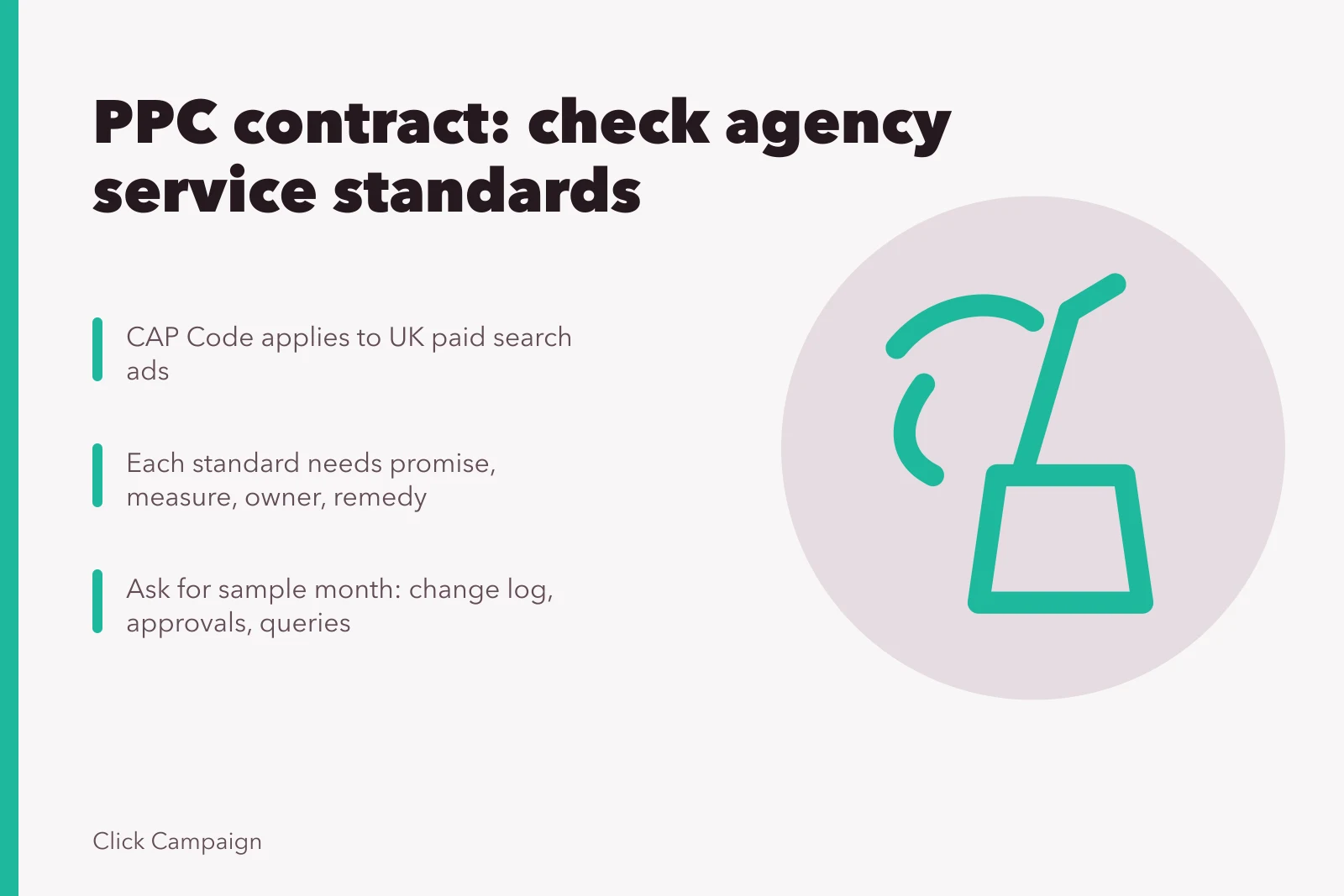
One part is not optional in England. Paid search ads are non-broadcast marketing communications, so they sit under the UK advertising codes enforced by the ASA. The CAP Code requires ads to be legal, decent, honest and truthful. An agency that treats copy review as the client's problem is not meeting a service standard.
Regulation is also moving. The government's Online Advertising Programme consultation examined a wider framework for online advertising, including paid search. Standards written now should leave room for that to tighten.
How should a client write the standard down?
Write it as a short schedule attached to the contract, not as prose in a pitch deck. Each line needs four parts: the promise, the measure, the owner and the remedy if it is missed.
Four parts of a service standard
- The promise
- The measure
- The owner
- The remedy if missed
A useful line reads: "All ad copy changes are checked against the CAP Code by the account lead before going live, logged in the change register and reviewed monthly." That is testable. "We maintain high quality" is not.
BSI publishes standards covering data quality and digital processes that give a neutral vocabulary for quality controls. That helps when two agencies describe the same work differently.
The wider operating model behind these schedules is set out in our guide to the PPC agencies operations and delivery framework, which explains how workflow, ownership and reporting fit together.
What response times and change controls are reasonable?
Reasonable depends on spend and risk, not on fashion. For a small account, next-working-day replies to non-urgent queries are common, as is same-day acknowledgement of a paused campaign.
Illustrative service standard figures
- £4,000monthly media spend
- £450monthly management fee
- 4 hoursacknowledgement window for spend anomalies
- Weeklychange log frequency
Change control matters more than speed. Ask who can edit budgets, who approves new ad copy and what happens out of hours. Get the answer in writing with a name attached.
For example, a team paying £4,000 a month in media might agree a £450 monthly management fee, a four-hour acknowledgement window for spend anomalies and a weekly change log. Those figures are illustrative, not market rates.
If the agency cannot describe its own escalation route, the standard will not survive a busy quarter.
What evidence should a client ask to see?
Ask for a sample month of working papers: the change log, the approval trail for ad copy, the query register and the reconciliation between platform spend and invoice.
This is the same evidence trail that supports a launch review, and our note on PPC agencies launch review data sources shows what a defensible pack looks like.
Two tests are quick. Can the agency show who approved a specific ad on a specific date? Does the spend reconciliation match to the penny? A no to either means the standard is aspirational.
How do you keep the standard alive after month one?
Put it on the agenda. A twenty-minute monthly service review covering misses and near misses keeps the schedule honest without turning it into a blame session.
Review the standard itself twice a year. Spend grows, team members change and regulation shifts.
Record the remedy when a standard is missed. A service credit, a root-cause note or a process change all work. Silence teaches everyone that the schedule is optional.
Common questions
Do service standards apply across the whole UK?
The CAP Code applies to ads shown in the UK, so the position is broadly the same in England, Scotland, Wales and Northern Ireland. Contract terms and remedies depend on the agreement between client and agency.
How many standards should a contract include?
Aim for five to eight. Beyond that nobody tracks them. Pick the ones that protect spend, compliance and reporting accuracy first.
Can a small advertiser enforce a standard?
Yes, if the remedy is written into the contract. Without a stated remedy, enforcement depends on goodwill, which is not a service standard.
Should copy approval sit with the agency or the client?
Both, in sequence. The agency checks the copy against the CAP Code, then the client approves the commercial claim. One signature is not enough.