Rules and ethics
Part of PPC agencies rules and ethics: a compliance guide for England
When to put PPC agencies commercial contracts under legal review
A working list of the triggers that should send a PPC agency contract to a qualified adviser, covering English law, data protection, ad standards and CMA routes.
What to take away
- English law governs most agency contracts signed with England-based clients, and the Consumer Protection from Unfair Trading Regulations 2008 still shape how services are described.
- Recent enforcement attention has fallen on how agencies describe results, handle client data and respond to complaints, so contract wording matters more than it did.
- Get a qualified adviser involved when a contract touches personal data, performance guarantees or competition-sensitive terms.
- The triggers below are a checklist for when to seek review, not a substitute for legal advice.
- Keep the [PPC agenciesUK rules and compliance guide for 2027](/ppc-agencies-uk-rules-and-compliance-guide-for-2027) open as your reference for the wider framework.
How to use this list
This list applies to England. Scotland, Wales and Northern Ireland have their own procedural differences in some areas, so check the jurisdiction named in your contract before relying on any point here.
The inclusion test is simple: a term appears if it has been the subject of regulator guidance, primary legislation or a published complaint route in the last few years. Nothing here ranks providers or recommends a particular firm.
When the contract touches personal data
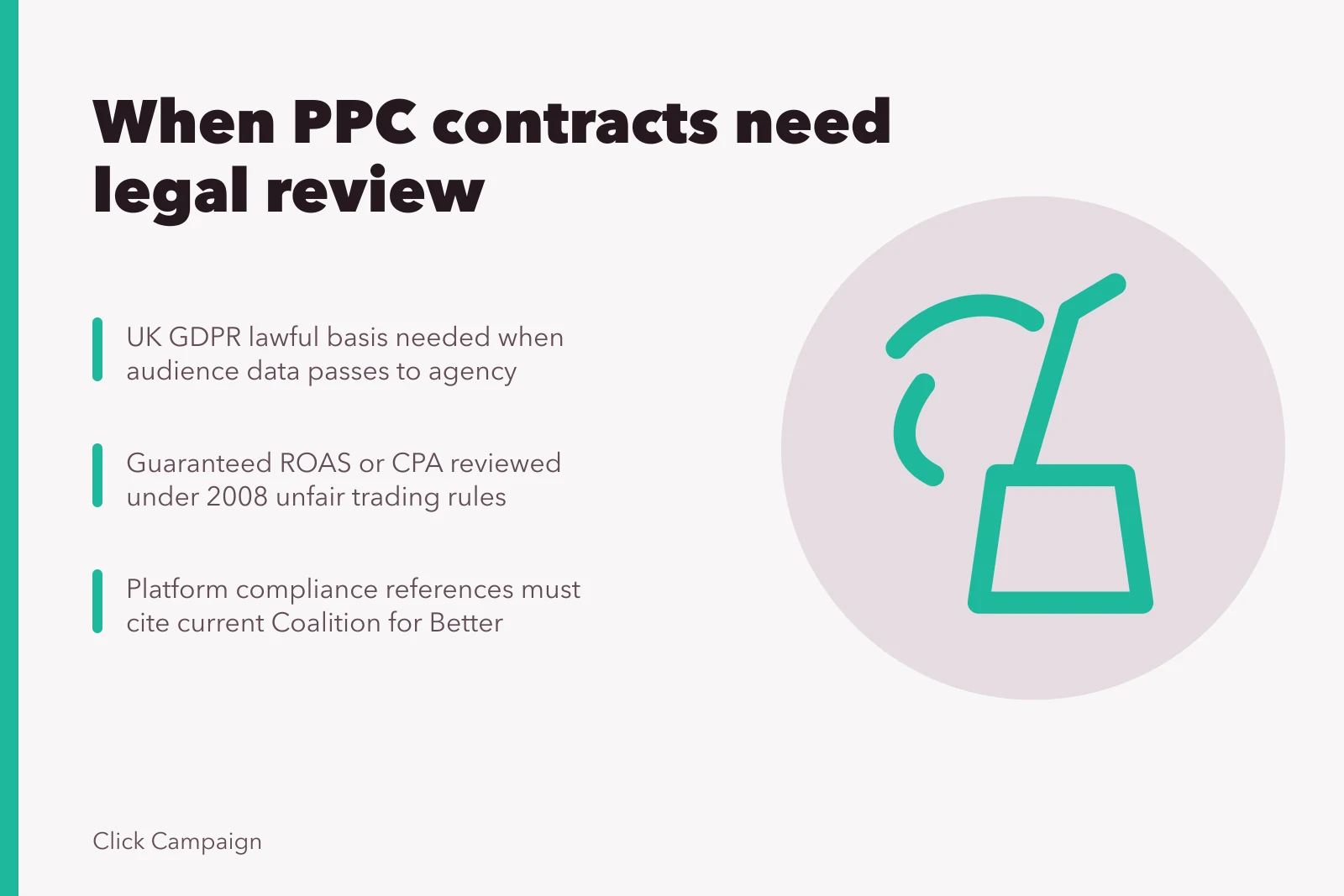
The UK GDPR sits alongside the Human Rights Act 1998 as part of the historical data protection picture, and any PPC contract that passes audience data to an agency needs a lawful basis recorded in writing. If your agency builds remarketing lists or shares conversion data with third parties, ask a qualified adviser to check the data processing agreement.
Data protection review triggers
- Audience data passed to agency
- Lawful basis recorded in writing
- Remarketing lists built
- Conversion data shared with third parties
- Check data processing agreement
This is also the point to read the PPC agencies disclosure policy in England, because disclosure duties and data duties often overlap in the same clause.
When results are promised in writing
Performance claims are a commercial risk as well as a legal one. If a contract guarantees a return on ad spend or a cost per acquisition, the wording needs to survive scrutiny under the Consumer Protection from Unfair Trading Regulations 2008. A qualified adviser should review any guarantee that is not qualified by budget, seasonality or platform change.
Is the performance promise qualified?
Does the contract guarantee ROAS or CPA?
Review under unfair trading rules
Check budget, seasonality, platform change
For example, a team paying £4,000 a month might be offered a fixed cost per lead. That is a promise, and promises attract enforcement.
When ad experience standards are referenced
The Coalition for Better Ads status published by IAB UK informs the ad formats that platforms restrict, and those restrictions feed directly into paid media performance. If your agency contract refers to platform compliance, make sure the reference is to the current standard rather than a version from several years ago.
When a dispute has no obvious route
Most agency disagreements are commercial, not regulatory. But where an agency's conduct looks like a market problem rather than a service complaint, the report a problem to the CMA route exists for businesses and consumers. Use it only after internal escalation has failed, and keep contemporaneous records.
When fees change mid-term
A mid-term fee increase is a contract variation. English law requires the mechanism to be clear in the original agreement. If the variation clause is vague, or the agency relies on a side letter, ask a qualified adviser to check enforceability before you sign an amended schedule.
When exclusivity or non-compete terms appear
Exclusivity clauses in PPC contracts can restrict who else you hire. In England, restraints must be reasonable in scope and duration to be enforceable. A twelve-month blanket ban on competing agencies is the kind of term that should go to a qualified adviser, especially if it survives termination.
When termination rights are one-sided
Check who can terminate, on what notice, and what happens to accounts and data afterwards. A contract that lets the agency exit in 30 days but binds the client for 12 months is unbalanced. This is a common trigger for review.
When intellectual property ownership is unclear
Campaign structures, ad copy, audiences and account history all carry value. If the contract is silent on who owns them at termination, that silence is a risk. Ask a qualified adviser to add an express clause.
Before and after a review
Before review
- Performance promise
- Open-ended guarantee
- Data processing
- Generic reference
- Fee variation
- Verbal understanding
- Termination
- One-sided
- IP ownership
- Silent
After review
- Performance promise
- Qualified by budget and platform
- Data processing
- Named lawful basis and retention
- Fee variation
- Written mechanism with notice
- Termination
- Mutual with handover terms
- IP ownership
- Express client ownership on payment
When to stop and get advice
Any clause that limits your ability to complain, move accounts or reuse your own data should pause the signing process. Individual cases need a qualified adviser, and this article is general guidance only.
Common questions
Does English law always apply to a PPC agency contract?
Not always. The governing law clause decides, but if the client and agency are both in England, English law is the usual default and English courts are the usual forum.
Do I need a lawyer for a small monthly retainer?
Not for every clause, but do get advice if the contract contains a guarantee, an exclusivity term or a data sharing schedule. Those three triggers carry the most risk.
Can I complain to a regulator about an agency?
Some conduct falls to the CMA under the competition route, and data issues fall to the ICO. Service quality complaints are usually a civil matter, so read the contract's dispute clause first.
How often should a PPC contract be reviewed?
Review it whenever scope, fees or data flows change, and at least once before any renewal. A contract signed three years ago may not reflect current platform terms.