Measurement
Part of When to question your PPC agency's measurement and reporting
PPC agencies should report platform metrics beside client ledger figures
A practical guide to the metrics PPC agencies report on, separating platform figures such as conversions and impression share from a client's revenue evidence.
What to take away
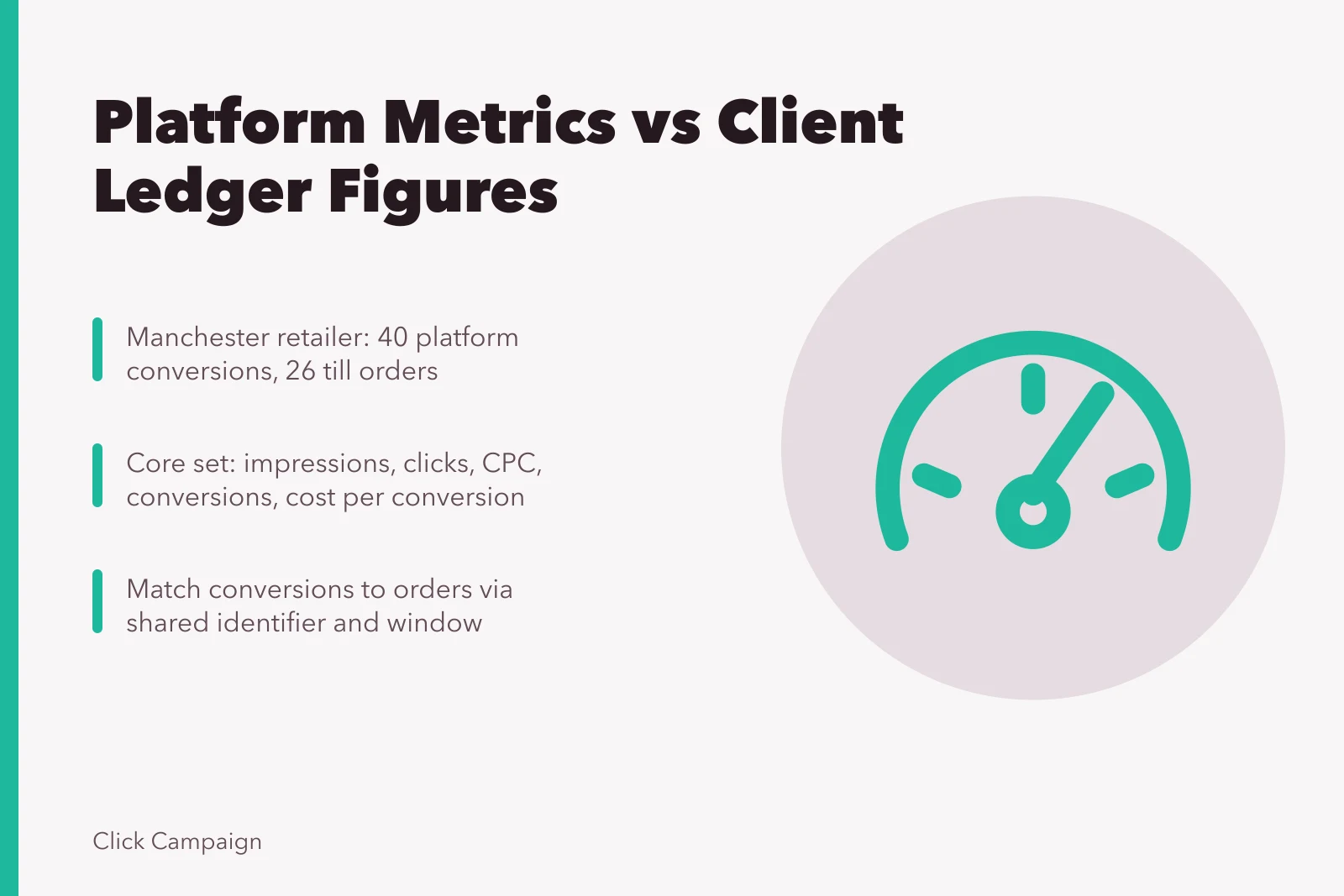
- A Manchester retailer sees 40 platform conversions in a week but 26 orders in its till. Platform metrics are directional; ledger metrics are evidential.
- Core paid search metrics are impressions, clicks, average cost per click, conversions and cost per conversion, all counted inside the ad platform.
- Revenue, gross margin and repeat-purchase rate usually live outside the platform and need a feed from the client's systems.
- Attribution windows and modelled conversions move reported totals, so the window belongs on the report, not in a footnote.
- Consent choices shape what can be tracked and stored, and the Data (Use and Access) Act 2025 covers much of that processing.
Where platform metrics stop
Platform reporting is fast, consistent and free to pull. It is also a closed view of what the platform saw, using its own definitions.
Platform view vs business view
Platform reporting
- Source
- Ad platform
- Speed
- Fast
- Scope
- What platform saw
- Definitions
- Platform's own
- Money proof
- No
Client ledger
- Source
- Finance and CRM
- Speed
- Slow to assemble
- Scope
- Revenue and margin
- Definitions
- Client's own
- Money proof
- Yes
The standard paid search set
Google Ads reporting covers impressions, clicks, click-through rate, conversions and cost per conversion. Impression share and lost impression share, split by budget and rank, add a competitive dimension. Google's guidance on getting the full value from your web and app channels sets out how its measurement and attribution approach works.
None of these numbers says whether the business made money. A 6% click-through rate is routine on a branded term and unusual on cold prospecting.
Conversion definitions vary
A conversion can be a form start, a completed form, a call over 60 seconds, or a purchase. Each definition gives a different cost per conversion from the same spend, so confirm which one applies before comparing months.
Paid social adds its own counting rules. Meta's documentation on how ad auctions work explains the delivery and measurement mechanics behind its reported conversions.
Where client evidence begins
Revenue, margin and retention come from the client's finance and CRM systems. They are slower to assemble.
Which metric leads by client type
What does the client sell?
Ecommerce: contribution margin per order
Lead gen: qualified lead rate
Building a comparable set
Match platform conversions to orders using a shared identifier, a date range and a stated window, then show both figures side by side. The measurement and reporting guide for 2027 explains how to present the two sets to a client board.
Expect a gap. Modelled conversions, cross-device journeys and consent-driven data loss all push platform totals above ledger totals. Its consistency matters more than its size.
Choosing which metrics lead
For an ecommerce client, contribution margin per order is the honest headline, while a lead generation client should watch qualified lead rate rather than raw lead volume. A subscription business should test first-order cost against 12-month value.
Reporting discipline and data rules
A metric is only useful if the reader knows its source, its window and its owner.
Naming sources and defining terms
Give the platform, the report name and the date range for every figure. Say when a number comes from the client's finance system, and say so again when it is modelled. Where a client wants both views on one screen, the guide to a reporting dashboard for England teams covers layout and definitions.
Worth pinning down:
- Impression share:
- the share of eligible impressions a campaign received.
- Attribution window:
- the period after a click when a conversion is credited.
- Modelled conversion:
- a conversion estimated by the platform, not directly observed.
- Cost per acquisition:
- spend divided by conversions, using a stated conversion definition.
- Contribution margin:
- revenue minus the variable costs of fulfilling an order.
Consent and lawful basis
Consent choices affect pixel firing, cookie storage and how much conversion data returns to the platform, so totals differ between consenting and non-consenting users. Document the lawful basis for each tracking method and keep the record current.
Common questions
What are the key metrics PPC agencies should report?
At minimum clicks, click-through rate, average cost per click, conversions and cost per conversion. Add impression share and spend, plus revenue or qualified lead rate where the client can supply them.
Why do platform conversions differ from my own order numbers?
Attribution windows, modelled conversions and consent-driven data loss all lift platform totals above a ledger. A difference is normal; an unexplained difference is the problem.
How often should the metric set change?
Review it when the business model changes, when a new tracking method goes live, or when a conversion definition changes. Otherwise hold the set stable so month-on-month comparisons stay meaningful.
Does UK data law change what can be measured?
Yes. The Data (Use and Access) Act 2025 covers much of the processing behind digital advertising, and consent choices affect how much conversion data reaches the platform.