Measurement
Part of When to question your PPC agency's measurement and reporting
Before you compare PPC agencies attribution methods, check these four things
A side-by-side look at the attribution methods PPC agencies use in England, what each one measures well, and the data duties that shape which model you can trust.
What to take away
- Most teams compare last-click with data-driven first. The bigger problem is usually a broken conversion feed, so fix tracking before judging any model.
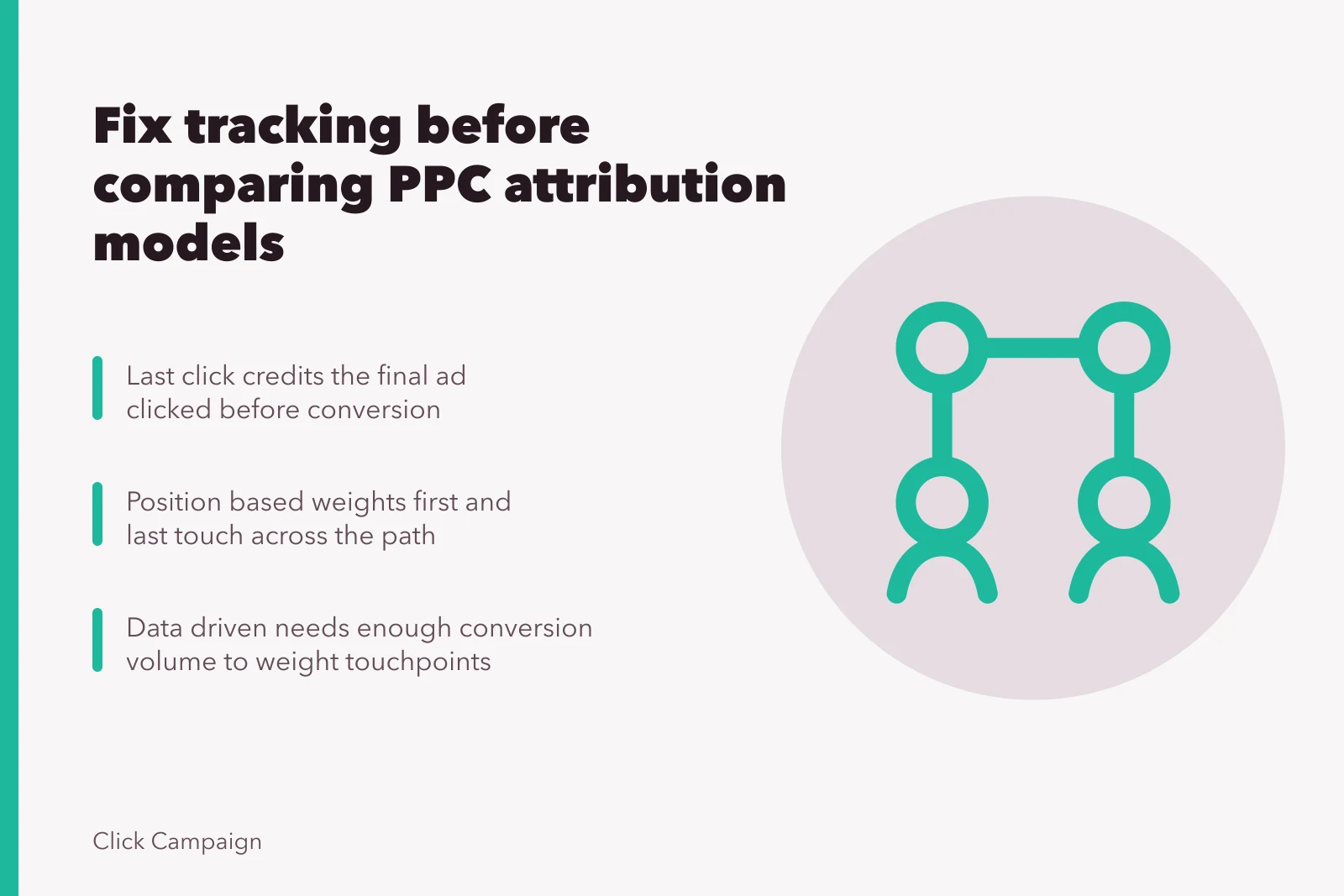
- Methods differ in what they countlast click credits the final ad, position based splits credit across the path, and data-driven models weight touchpoints by observed conversion patterns.
- Google Ads only reports across web and app channels when conversion tracking and consent signals are configured properly.
- Any model processing personal data must respect the rights the Information Commissioner's Office sets out, which affects what you can target.
Why does the first model choice rarely matter most?
Agency pitches often open with the model. In practice, the biggest swings in reported return come from tracking gaps: missing consent, duplicated conversions, or offline sales never uploaded.
If the feed is wrong, every model inherits the error. Google's guidance on getting the full value from your web and app channels treats measurement and attribution as one connected job, not a switch you flip in the interface.
Treat the model as the second decision. The first is whether your conversion data is complete and deduplicated.
Which attribution methods do PPC agencies actually use?
Four methods dominate most English accounts.
Attribution Methods Compared
Last click
- What it credits
- Final ad clicked
- Best suited to
- Short paths
First click
- What it credits
- Ad that started journey
- Best suited to
- Demand generation
Position based
- What it credits
- First and last touch
- Best suited to
- Longer consideration cycles
Data driven
- What it credits
- Observed patterns
- Best suited to
- Enough conversion volume
Ask which method drives bidding and which drives reporting. They differ, and the gap explains many confusing monthly numbers.
For a fuller view of how these choices feed into client reporting, the measurement and reporting guide for 2027 sets out the wider framework.
How do you compare models on the same account?
Run them in parallel on one dataset rather than comparing two agencies' decks.
Pick a quarter. Export conversions by channel under each model. Then ask what changed in the bidding algorithm, not just in the report.
A worked example helps. Suppose a client spends £30,000 a month on paid search and £12,000 on paid social. Last click assigns 80 per cent of the £42,000 credited conversions to search. A position-based model might shift 15 percentage points to social. Neither figure is wrong; they answer different questions.
Decide the question before reading the number; budget defence and channel investment need different models.
What data duties shape which model you can run?
Attribution joins up user journeys, which means personal data. Under UK GDPR, individuals can access, correct and object to how their data is used. The ICO's guide to individual rights sets out what organisations must be able to do when someone asks.
That has practical consequences. If a customer objects to marketing processing, their joined-up path breaks. Models relying on long lookback windows and cross-device matching carry more of this risk than simple click counting.
Ask how the agency handles erasure requests inside the reporting stack, not just in the CRM.
Does the model change what you report to the board?
Board packs want one number. Attribution gives you several, each defensible.
Match the model to the decision in front of the reader. For channel budget shifts, a data-driven view travels better. For a sanity check on a single campaign, last click is fine.
Keep definitions stable for at least two quarters. Changing model mid-year makes trend lines meaningless. The reporting dashboard in England covers how to present these figures without overloading the reader.
How should an agency explain model limitations?
A good agency names what its model cannot see. Walled gardens, offline conversions and view-through exposure sit outside most click-based methods.
The CIPD's people analytics resources are written for HR teams, but the caution about acting on incomplete evidence applies here. Treat attribution output as one input, not a verdict.
Ask for a written note on known blind spots. If the answer is that the platform handles everything, that is a warning sign.
Common questions
Is data-driven attribution always better than last click?
Not always. It needs enough conversion volume to weight touchpoints reliably. Small accounts often get more stable reporting from simpler rules.
Can two agencies report different numbers for the same account?
Yes, regularly. Different models, lookback windows and consent handling all produce different totals from the same spend.
What should I ask before signing an attribution contract?
Ask which model drives bidding, which drives reporting, how consent gaps are handled, and who owns the conversion data if you leave.