Costs and pricing
Part of Compare PPC agency management fees and media budgets before you sign
Before you sign, check the PPC agencies hidden costs in the paperwork
PPC agencies hidden costs that buyers should check before signing, covering data licensing, tracking, media mix and the sources behind each figure.
What to take away
- Most teams check the monthly retainer first and the data, tracking and media clauses last. That is where the largest PPC agencies hidden costs sit.
- Read the scope document before the price table. Anything billed outside scope is where budgets drift.
- Ask for a written inventory of the data sources, tracking tools and third-party licences the agency will bill back.
- Treat every quote as a range. Ask what happens to fees if spend or data volumes change mid-term.
- Keep the commercial assumptions in one place so finance, marketing and legal read the same numbers.
Why do PPC agencies hidden costs start in the scope document?
A retainer describes effort, not volume. If the contract says campaign management without a CAP on accounts, ad groups or markets, the agency can bill extra work as a change request.
Scope clauses to check
- Cap on accounts, ad groups, markets
- Which creative deliverables are fixed
- Which items are priced per item
- Product feed threshold in writing
- Substantiate any advertising claims
The same applies to creative. A fee covering ad copy may exclude landing page edits, feed work or localisation, so ask which deliverables are fixed and which are priced per item.
Volume triggers deserve the same scrutiny. A contract may permit, for example, two product feeds before each extra feed becomes chargeable. Ask for that threshold in writing.
Misleading advertising claims are separately regulated. The Consumer Protection from Unfair Trading Regulations 2008 set out when a commercial practice, including an advert, counts as misleading. That matters when an agency writes claims a client cannot substantiate.
For a full breakdown of fee models, read PPC agencies costs and budget guide for England before you compare quotes.
Which data and tracking costs sit outside the retainer?
Data licensing is a common line item. Audience segments, third-party intent data and enrichment tools are often billed at cost plus a handling fee.
Costs outside the retainer
Cost line
- Data licensing
- Audience segments, intent data
- Tracking
- Server-side tagging, consent, calls
- Feed platforms
- Product data tools for retail
What it covers
- Data licensing
- Lawful source and consent
- Tracking
- Who owns the tag container
- Feed platforms
- Whose licence is it
Ask before signing
- Data licensing
- Tracking
- Feed platforms
Tracking is the second line. Server-side tagging, consent management and call tracking each carry setup and monthly fees. Ask who owns the tag container when the contract ends.
Feed platforms and product data tools are a third line. Retail and travel accounts often need one, and that licence sometimes sits with the agency rather than the client.
The ICO has published guidance for organisations using marketing services of data brokers. It explains the checks buyers should make on lawfulness and consent. If a segment cannot be traced to a lawful source, the saving is not worth the risk.
Does paid search alone cover the media mix?
No. Many agencies now bundle paid social into a PPC retainer. LinkedIn publishes advertising resources, tips and best practices for its own platform. Reviewing that material helps a buyer judge whether proposed paid social work is priced sensibly.
If the mix includes social, the fee may be split by channel. That split is rarely shown in the headline retainer, so ask for a channel-by-channel breakdown.
What does a worked example look like?
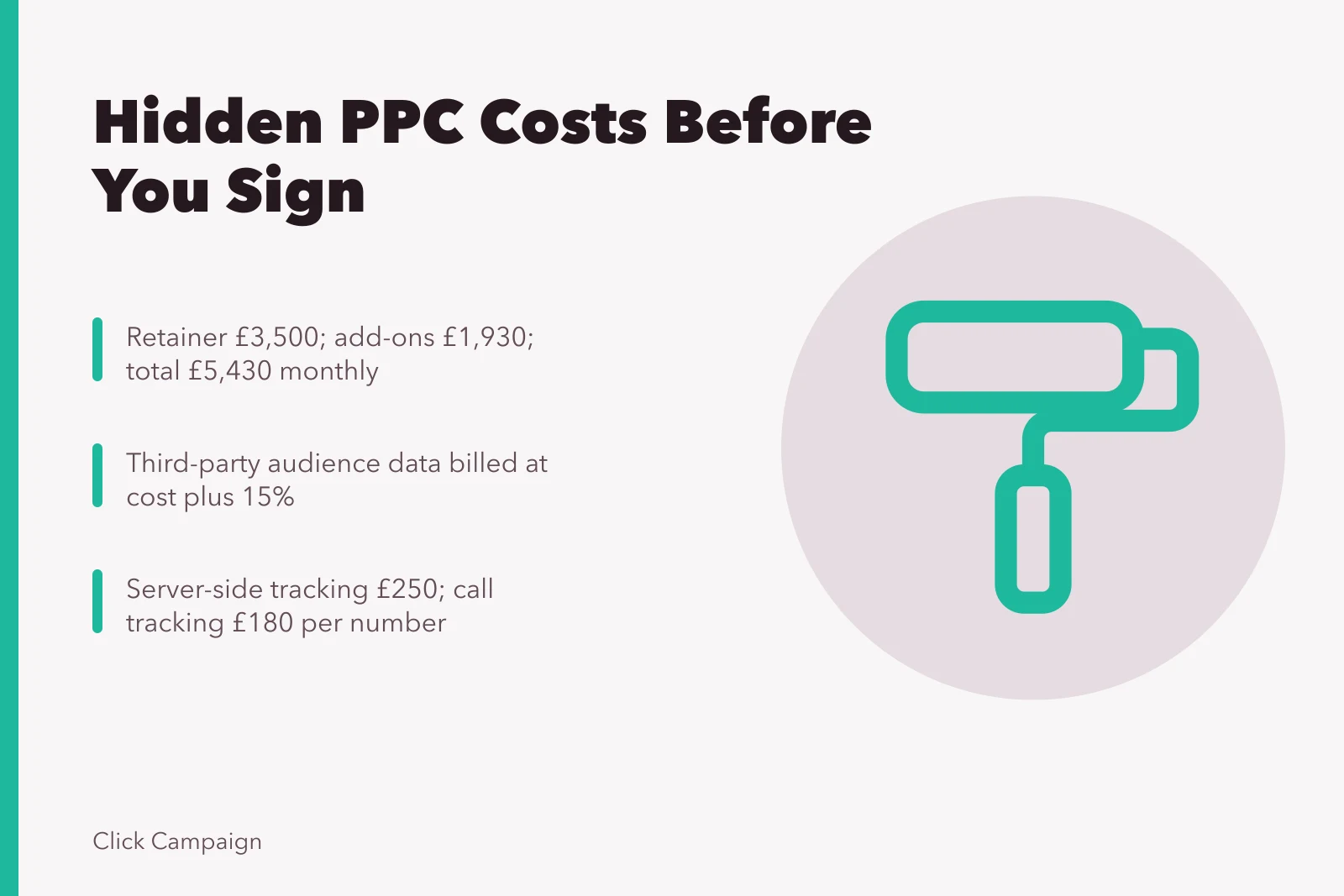
Assume a mid-sized English retailer with a stated monthly retainer of £3,500. The illustrative add-ONS below are typical of the clauses described above, not a market average.
Worked example
| Item | Monthly figure | Basis |
|---|---|---|
| Retainer | £3,500 | Fixed fee |
| Third-party audience data | £600 | Billed at cost plus 15% |
| Server-side tracking | £250 | Platform fee |
| Call tracking | £180 | Per number, per month |
| Paid social management | £900 | 20% of social spend |
| Total | £5,430 |
The gap between £3,500 and £5,430 is the point. Nothing here is dishonest, but the retainer alone understates the commitment by roughly 55%.
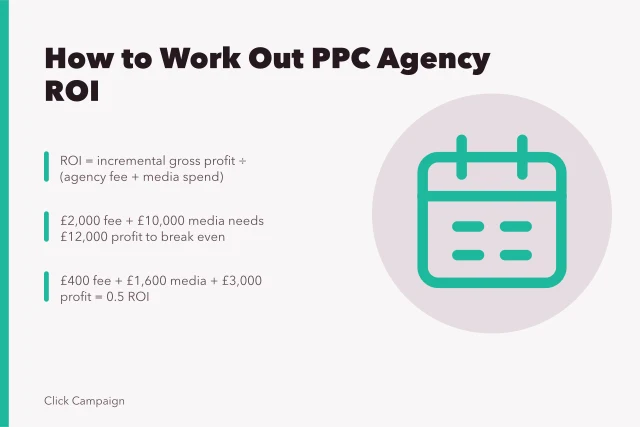
Before agreeing, model what the same work returns. PPC agencies return on investment in England shows how to set that baseline.
How should you compare two quotes fairly?
Put both quotes into one table with the same rows. Add every pass-through cost, licence and platform fee, then the notice period and any exit fee.
Set the comparison over the full term, not one month. Setup fees, annual uplifts and exit fees only surface when you spread them across twelve months.
Ask which figures are fixed for the term and which are indexed. A small annual uplift on a large data bill compounds quickly.
Finally, agree who audits the invoices. A monthly reconciliation clause is cheaper than a dispute.
Common questions
Are hidden costs always avoidable?
No. Some pass-through costs are genuine and outside the agency's control. The aim is to see them before signing, not to remove them.
Should data licensing sit with the agency or the client?
Either can work. What matters is that the contract names the licence holder and states what transfers if the relationship ends. Ask for that in writing, not on a call.
What is the single most useful question to ask?
Which costs are excluded from this fee? Ask it in writing and keep the reply with the contract.
Do these costs differ across the UK?
The commercial pattern is broadly similar, but VAT registration and data rules can apply differently in Scotland, Wales and Northern Ireland. Check the contract against the jurisdiction you trade in.