Costs and pricing
Part of Compare PPC agency management fees and media budgets before you sign
How do you work out PPC agencies return on investment?
A step-by-step method for working out PPC agency return on investment in England, with labelled figures, a decision table and the data that keeps the sums honest.
What to take away
- Consent comes before any return figurethe cookie rules for PPC tracking, The Privacy and Electronic Communications (EC Directive) Regulations 2003, have been in force since December 2003.
- Return on investment is incremental gross profit divided by agency fee plus media spend. Click cost alone tells you nothing.
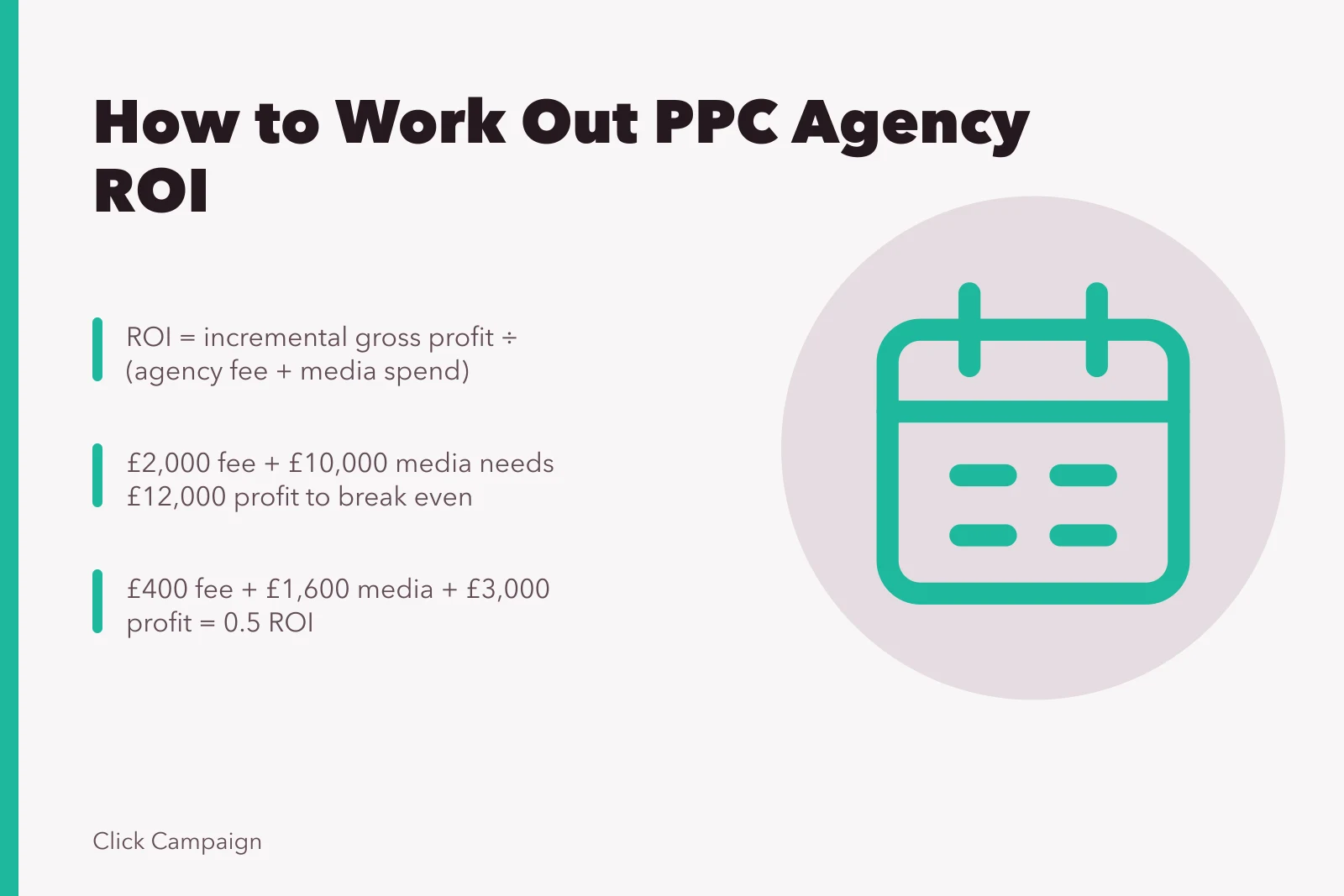
- An agency fee of £2,000 a month against £10,000 of media needs £12,000 of gross profit to break even, so your own margin sets the bar.
- Count contribution margin, not revenue, because a business on 20% margin needs five times the sales of one on 100%.
- Agree the review date before signing, and check every line of the proposal against the PPC agencies costs and budget guide for England.
Step 1: agree the numbers you will compare
Start with three figures: media spend, agency fee and gross profit per sale. A £500 service at 40% gross margin carries £200 of profit per sale. An agency charging £1,500 a month plus £6,000 of media needs £7,500 of gross profit, roughly 38 sales, before the campaign breaks even. Write that target down first.
Break-even figures to agree
- £200profit per sale
- £7,500gross profit needed monthly
- 38sales to break even
- £6,000profit for 3.0 return
Fix the target before the first click. If your business wants a 3.0 return, a £2,000 monthly outlay must produce £6,000 of incremental gross profit. That figure keeps month-end conversations factual rather than anecdotal.
Step 2: separate incremental profit from existing sales
Only sales you would not have made anyway count. A brand already ranking first for its own name still collects paid clicks on that term, and those are not incremental. Ask the agency to report branded and non-branded separately, and to strip out sales that organic or direct traffic would have delivered regardless.
Incremental vs existing sales
Incremental
- Branded search
- Strip out
- Organic or direct
- Strip out
- New customers
- Counts
- Geo test
- Paid region
Existing
- Branded search
- Counts
- Organic or direct
- Counts
- New customers
- Strip out
- Geo test
- Holdout region
A geo test can settle the question. Run paid search in one region and hold it back in another with a similar sales pattern, then compare the two. Where a test is impractical, ask what share of conversions came from new customers rather than returning ones.
Step 3: build the tracking before the spend
Conversion measurement rests on tags and cookies, and consent is required before non-essential cookies are set. Audit them in month one: a broken tag hides a losing campaign or flatters a mediocre one. Google's documentation on conversion measurement explains how reported conversions are defined, and your profit calculation has to use the same definition.
Tracking audit before spend
- Audit tags and cookies in month one
- Check consent before non-essential cookies
- Fix broken tags hiding losing campaigns
- Match reported conversions to profit definition
- Note share of sessions that consented
Missing consent shows up as missing conversions. Where a large share of visitors reject cookies, the reported figure understates real sales and your return calculation reads low. Ask what share of sessions consented, and note it beside the result.
Step 4: calculate return on investment
The formula is incremental gross profit minus agency fee minus media spend, divided by agency fee plus media spend. A team paying £400 a month in fees and £1,600 in media that generates £3,000 of incremental gross profit keeps £1,000. Divide that by £2,000 and the return is 0.5, or 50%. Below zero, the arrangement loses money.
Payback timing matters as much as the ratio. If incremental profit arrives over nine months, a 1.5 return can still leave a cash gap in the first quarter. Ask when cumulative profit crosses zero.
Keep the media and fee lines separate in the report. Blending them hides whether the agency or the auction is driving a change in cost per acquisition.
What belongs in the denominator?
Fee and media, plus the recurring extras: landing page builds, feed management, analytics setup. Charges outside the fee erode return quietly, and the PPC agencies hidden costs: data and sources page lists the ones buyers most often miss.
How do you handle a wobbly month?
Judge on a rolling quarter. Seasonality and auction pressure move costs around, so compare the quarter's cost per acquisition with the target you set in Step 1 rather than reacting to one weak month.
Which route fits your situation
Match the buying model to your budget and your margin.
Choose
- Under £2,000 monthly media spend
- A freelancer or an in-house build
- £2,000 to £20,000 monthly media spend
- A specialist PPC agency on a fixed fee
- Lead generation with long sales cycles
- An agency that tracks qualified leads
- E-commerce on tight margins
- An agency focused on contribution margin
- Regulated sectors such as finance or health
- An agency with compliance experience
Avoid
- Under £2,000 monthly media spend
- A full-service agency retainer
- £2,000 to £20,000 monthly media spend
- Percentage-of-spend deals above 15%
- Lead generation with long sales cycles
- Agencies reporting clicks only
- E-commerce on tight margins
- Agencies reporting revenue as return
- Regulated sectors such as finance or health
- Generalists learning your rules
B2B lead generation often sits on LinkedIn, and its ad resources for marketing agencies show how campaign costs behave there. Cost per lead runs higher than on search, but deal values are larger.
Common questions
How often should I recalculate PPC agencies return on investment?
Recalculate monthly with the same formula, but change your judgement only after a full quarter. Keep a rolling twelve-month view for planning.
What counts as a good return on investment?
There is no universal figure: a business on 10% margins needs far more revenue than one on 60%. Set the target from your own gross profit per sale, and treat a return above 1.0 as a reasonable benchmark.
Can I compare agencies on return alone?
No, because each agency inherits a different account, budget and market. Compare like for like: same period, same margin assumptions, same tracking.
What is the biggest mistake buyers make?
Counting revenue instead of gross profit. A £100,000 revenue month at 5% margin contributes £5,000, which may not cover a £3,000 fee plus media.