Reviews
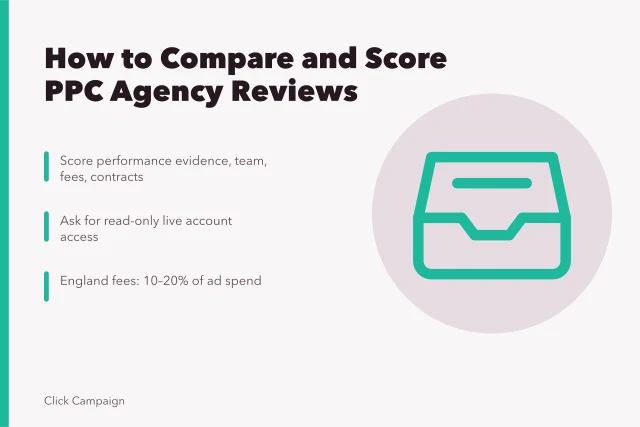
Part of How to compare and score PPC agency reviews explained
Check the data sources behind PPC agencies agency reviews
A review-method guide to PPC agencies agency reviews, showing which sources are assessable, which are marketing claims, and how to weigh the evidence.
What to take away
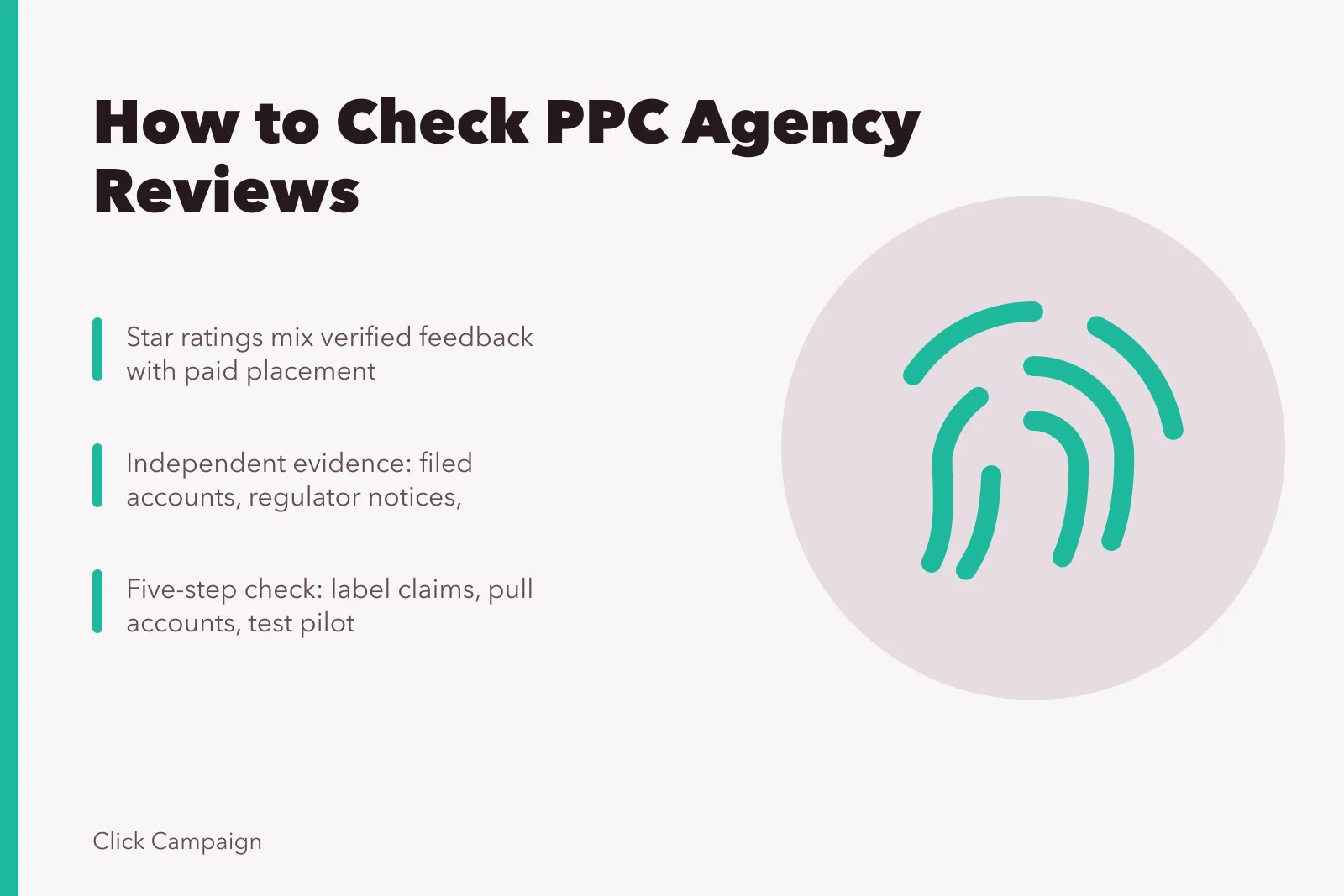
- Star ratings on review platforms mix verified client feedback with paid placement, so treat them as a shortlist tool, not proof.
- Independent evidence sits in filed accounts, regulator guidance and platform documentation, not in award badges.
- Score every claim by who made it and whether a named method sits behind it.
- Test a shortlist in a scoped paid search pilot before you commit a year of budget.
What this review assessed and what it did not
This review assessed the public evidence trail behind PPC agencies agency reviews: how platforms describe verification, what regulators require of advertisers, and what a buyer can check without contacting the agency.
It did not involve hands-on testing, interviews with agency staff or access to client dashboards. No agency is scored here. The method below is editorial judgement built on published sources, and you should apply it to your own shortlist.
Separate vendor claims from independent evidence
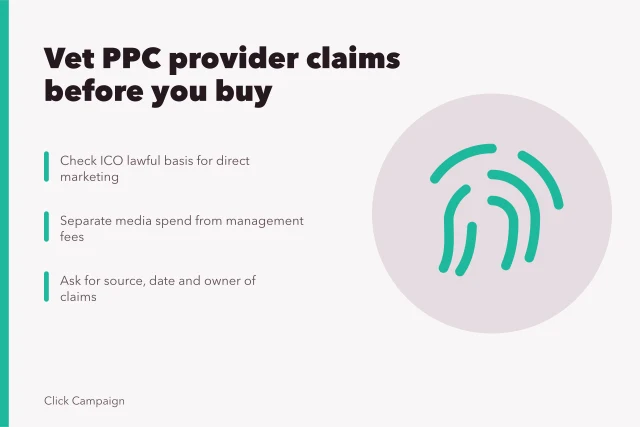
A case study published by an agency is a vendor claim. It may be accurate, but the agency chose what to show. Independent evidence comes from someone with no commercial interest in the sale: a filed account, a regulator notice, platform guidance.
Vendor claims vs independent evidence
Vendor claim
- Source
- Agency case study
- Commercial interest
- Yes, in the sale
- Selection
- Agency chose what to show
- Example
- Retention figure
Independent evidence
- Source
- Regulator or platform
- Commercial interest
- None
- Selection
- Filed or published record
- Example
- Filed accounts
Watch for loose citations. The Climate Change Act 2008 is climate legislation, not advertising law, and a supplier who points to the wrong statute in a bid document has probably not read the right one.
Score the review platform before the agency
Four questions for a review platform
- Who wrote the review?
- Can it show a paying client?
- Does the agency pay for placement?
- Is the scoring formula published?
- How are disputes handled?
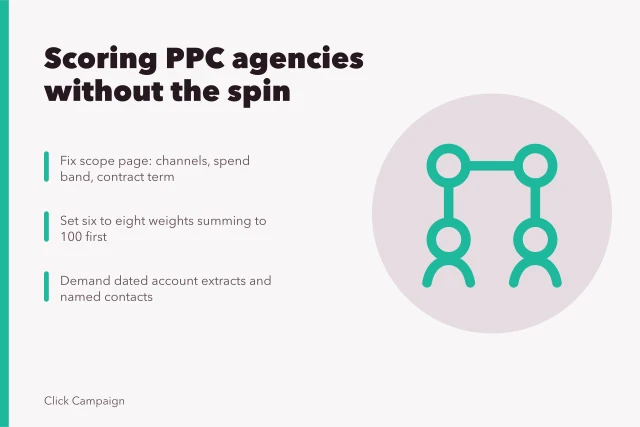
If those answers are vague, downgrade the platform's weight. A named method matters more than review volume. The same discipline appears in PPC agencies reviews and comparison methods for 2027, where scoring rules are fixed before suppliers are contacted.
A five-step evidence check
- List every claim you want to rely on, such as average cost per acquisition or retention rate.
- Label each claim as vendor, platform or independent, and note its publication date.
- Pull the agency's filed accounts and check the company number matches the trading name.
- Read the platform's verification wording and check whether paid placement exists.
- Record what stays unverified and decide whether a pilot would close the gap.
For example, a team comparing three agencies may find two publish retention figures with no method. The third publishes a dated client list. Only the third claim can be checked, so it carries more weight even if the number looks smaller.
Use platform guidance as a benchmark
You cannot see an agency's account structure before contracting, but you can read the platform's published practice. Google's guidance on how to be successful with Google Ads sets out campaign and measurement expectations any paid search supplier should describe plainly.
Use it as a question bank, not a scorecard: ask about conversion tracking, budget pacing and search term review. Vague answers are a signal.
The SME Toolkit from IAB UK is written for smaller advertisers running paid search, so its practical resources work as a neutral reference when you draft briefing questions.
What a pilot can and cannot prove
A pilot with a fixed budget and period answers one question: can this team deliver a defined task to an agreed standard? It says nothing about long-term retention or performance at scale.
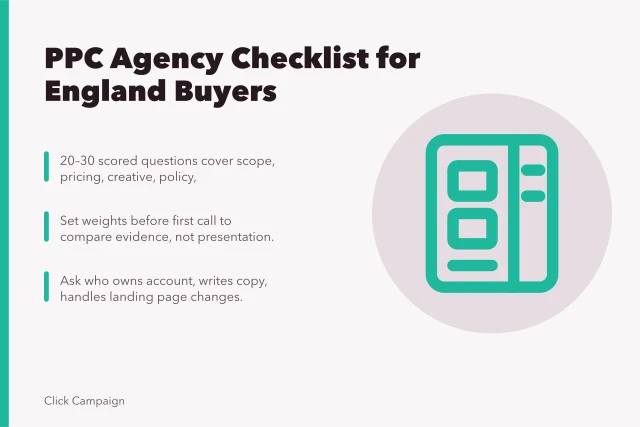
Set the brief before you see pitches so the comparison stays fair. The product-level checks in PPC agencies product comparison in England help when a pilot covers reporting and account access rather than spend alone.
Common questions
Are agency review sites reliable?
Useful for spotting patterns, not for final decisions. Reliability depends on whether the platform publishes its verification method and whether agencies pay for placement. Treat any score without a stated method as opinion.
What counts as independent evidence about a PPC agency?
Filed accounts, regulator publications, platform documentation and dated client references you can verify. Anything the agency wrote about itself is a claim, however well presented.
Can I check an agency's results without a pilot?
Only indirectly. You can confirm the company exists, read its published method and ask for references. Performance on your own account can only be observed once work begins.
How much weight should awards carry?
Little, unless the judging criteria and entrant list are published. An award shows an agency entered and won a competition, not that it delivers paid search results for a client like you.