Reviews
Part of How to compare and score PPC agency reviews explained
Before you trust PPC agencies best providers lists, check these sources
A source checklist for buyers weighing PPC agencies best providers, covering consent evidence, cost benchmarks and staff skills, plus a worked pounds example.
What to take away
- The usual mistake is trusting a provider's own ranking or award badge instead of the source behind the claim.
- Set inclusion criteria firstUK or England coverage, named data sources, and a written lawful basis for any audience data used in targeting.
- Cost comparisons only work when the benchmark is dated and attributed.
- Skills claims should map to recognised training rather than a slide deck.
- Score providers on evidence quality, not on who appears first in a listicle.
Which sources should sit behind a provider shortlist?
Start with the legal foundation. Any provider handling prospect lists for paid search should explain its lawful basis for direct marketing. The ICO's guidance on choosing a lawful basis for direct marketing is the reference to test that answer against.
Source checklist for shortlists
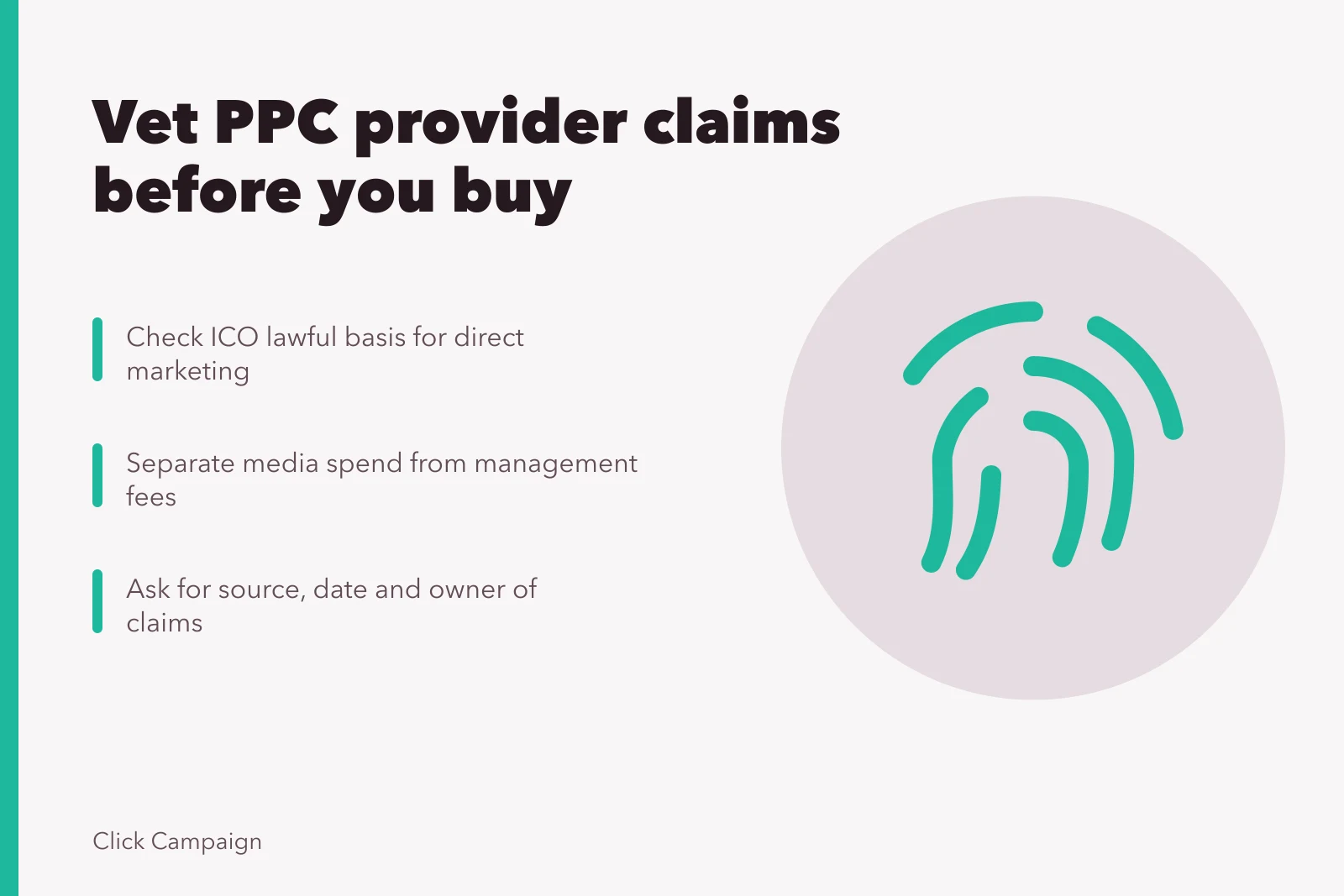
- ICO lawful basis for direct marketing
- LinkedIn advertising costs and pricing
- CIM digital marketing training courses
- PPC agencies reviews comparison methods 2027
Next, separate platform costs from agency fees. Agency retainers vary, but media costs have public anchors: LinkedIn publishes its own advertising costs and pricing, which helps when a provider forecasts cost per lead on that network. A forecast built on undated numbers is a guess with a logo on it.
Finally, check how the team keeps its skills current. A provider that funds structured development, such as digital marketing training courses from CIM, is easier to assess than one listing certifications without renewal dates. Our guide to PPC agencies reviews and comparison methods for 2027 shows how to turn these checks into a repeatable scoring sheet.
How do you compare providers without ranking them yourself?
Do not rank. Rank ordering invites scores you cannot defend, and it tells the reader nothing about their own account. Publish your inclusion criteria instead and let the reader apply them.
Useful criteria include a named contact for compliance questions, a documented process for audience data, and a cost model that separates media spend from management fees. Geography matters as well: a provider serving England only may price differently from one covering Scotland, Wales and Northern Ireland, so state what you need before requesting quotes.
What does a worked example look like?
Say a team pays £2,500 a month in management fees and £18,000 a month in media, so £20,500 a month in total. These are illustrative figures, not market averages.
The provider claims it will cut cost per acquisition by 20% within a quarter. Ask what the baseline is, which period it covers, and whether the figure is blended across channels or specific to paid search. A blended number can improve when an unrelated channel performs well.
Now test the fee. If the same scope is quoted at £1,800 a month elsewhere, the £700 monthly difference is £8,400 a year. That gap needs an explanation: fewer hours, less senior oversight, or a narrower scope. None is automatically wrong, but the reason should be written down.
Supplier comparison paperwork has to hold together across quotes, and our piece on PPC agencies product comparison in England explains how to keep it consistent.
Last, check whether the media forecast rests on a dated platform benchmark. A projection citing LinkedIn advertising pricing from an earlier year is stale until updated.
Which claims should trigger more questions?
Any claim that cannot be traced to a document deserves a follow-up. Ask for the source, the date and the person who owns it.
Be wary of guarantees tied to rankings or impressions, because neither maps cleanly to revenue. Be equally wary of consent language that describes cookies but not the lawful basis for contacting people.
A provider that answers plainly is easier to work with than one that answers with awards. Awards measure submissions, not delivery.
Common questions
Should I ask for client references?
Yes, but treat them as one input. Ask referees the same questions you asked the provider, and check whether their account resembles yours in size and sector.
Do I need an England-only provider?
Not necessarily. What matters is whether the provider understands the rules and market where your customers sit. If you sell across the UK, confirm coverage in Scotland, Wales and Northern Ireland too.
How many providers should I compare?
Three or four is usually enough to see the range in fee models and evidence quality. More adds reading time without adding much information.
Can I rely on a provider's own case studies?
Only as context. A case study without a dated baseline and a stated method is marketing copy, so ask for the underlying numbers before you weight it.