Measurement
Part of PPC agency case studies from UK brands: what success looks like
PPC agency case studies from UK brands: what success looks like
PPC agency case studies from UK brands: named examples from giffgaff, Specsavers, Crown Paints, M&S and Virgin Atlantic, plus how to read spend, dates and results.
What to take away
- Public UK examples include giffgaff with Brainlabs, Specsavers with Journey Further, Crown Paints with Impression, Marks & Spencer with Croud and Virgin Atlantic with Jellyfish.
- These pages name the sector and channel. Most hide media spend, so ask for pounds and dates.
- Check the baseline, the date range and the attribution model before you trust an uplift.
- Compare the claim with your own account before you sign a retainer.
Five UK case studies to read
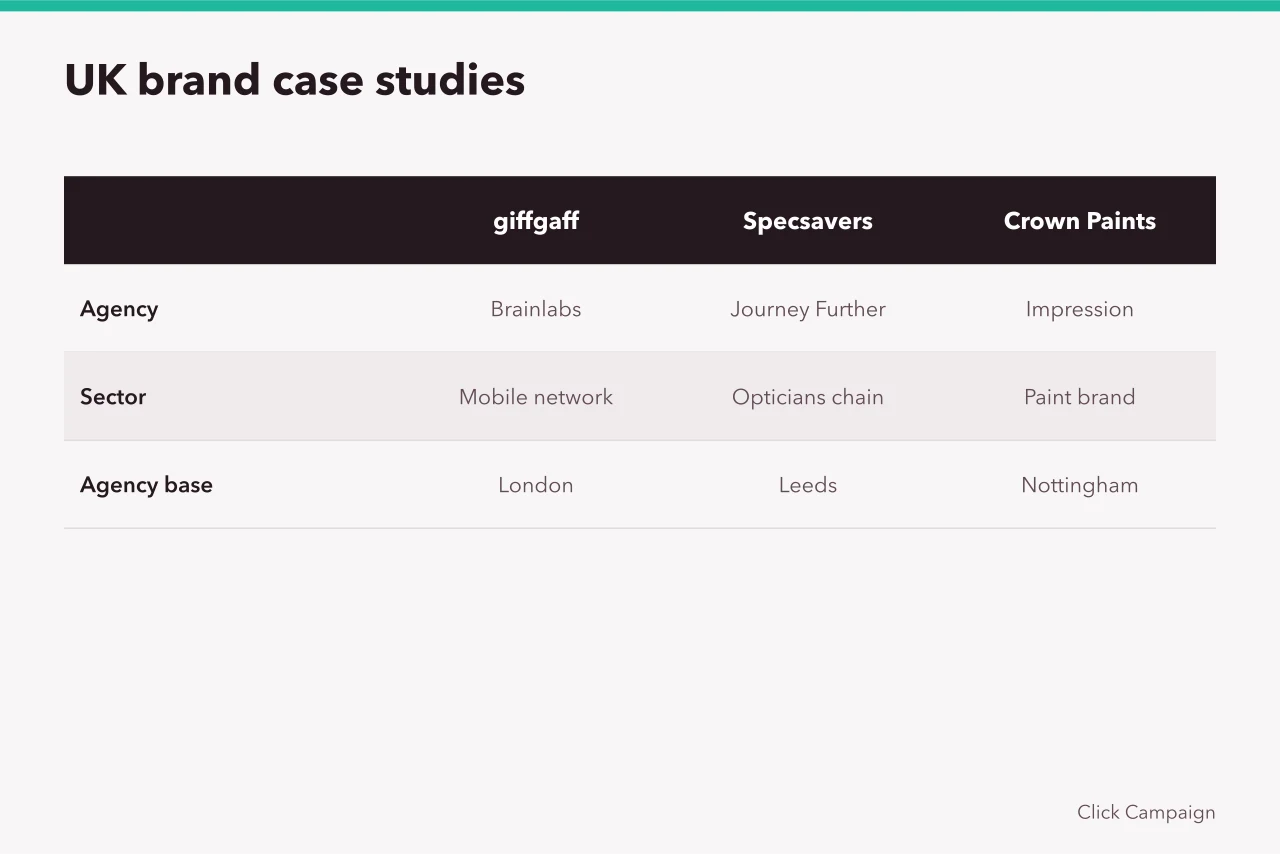
| UK brand | Agency | What the public page shows | Fact to act on |
|---|---|---|---|
| giffgaff | Brainlabs | Paid search for a mobile network | Brainlabs is a London agency founded in 2012. |
| Specsavers | Journey Further | PPC for an opticians chain | Journey Further is a Leeds agency founded in 2017. |
| Crown Paints | Impression | PPC for a paint brand | Impression is a Nottingham agency and B Corp. |
| Marks & Spencer | Croud | Paid search for a retailer | Croud is a Shrewsbury-founded agency with a freelance network. |
| Virgin Atlantic | Jellyfish | Paid search for an airline | Jellyfish is a global agency with a London office. |
Most public pages hide spend. Ask for the starting point, the end point and the exact months.
What separates evidence from a pitch
A pitch deck says the agency grew revenue by 240%. A case study names the brand, the months, the spend in pounds and the metric that moved. If any of those four is missing, treat the number as decoration.
Four signs of real evidence
- Names the brand
- Gives the months
- States spend in pounds
- Names the metric that moved
Ask for the starting point as well as the end point. An account that grew from £2,000 to £8,000 a month in spend tells a different story from one that held spend flat and doubled return on ad spend.
Good agencies also say what they did not do. If the uplift came from a wider brand campaign, a website rebuild or a price change, that should be stated.
Which figures to ask for
| Metric | What it tells you | Question to ask |
|---|---|---|
| Return on ad spend | Revenue for each pound of ad spend | Is revenue measured in the ad platform or in your CRM? |
| Cost per acquisition | What each sale or lead costs in total | Does the figure include agency fees? |
| Conversion rate | How well the landing page turns clicks into actions | Was the attribution model consistent across the period? |
| Impression share | How much of the available search demand you win | Was the budget capped at any point? |
| Lead quality | Whether enquiries turn into paying customers | Who verified that the leads were genuine? |
Metrics only help if the measurement window is fixed. Ad platforms report conversions on the day of the click by default, which flatters long sales cycles. Ask whether the case study uses platform numbers or a CRM-matched view.
Metrics and questions to ask
Metric
- Return on ad spend
- Revenue per pound
- Cost per acquisition
- Cost per sale
- Conversion rate
- Landing page performance
- Impression share
- Search demand won
- Lead quality
- Enquiries to customers
What it tells you
- Return on ad spend
- Platform or CRM?
- Cost per acquisition
- Includes agency fees?
- Conversion rate
- Attribution consistent?
- Impression share
- Budget capped?
- Lead quality
- Who verified leads?
Question to ask
- Return on ad spend
- Cost per acquisition
- Conversion rate
- Impression share
- Lead quality
If your goal is enquiries rather than sales, a PPC agency for lead generation should show the cost of qualified leads, not raw form fills. Ask how many of the quoted leads became customers.
Seasonality and the dates behind the numbers
The ONS retail industry data tracks monthly UK retail sales and shows the build-up to the November and December peak. A campaign that ran across that period faced different auction pressure from one that ran in a quiet February.
Retail year and auction pressure
- November-DecemberPeak retail, highest auction pressure
- JanuaryQuiet start, weaker comparison
- FebruaryQuiet month, lower pressure
- Six-month windowIncludes Christmas quarter, looks stronger
Ask for the exact date range of any case study. A six-month engagement that includes the Christmas quarter will usually look stronger than one starting in January, even if the work was identical.
Rules that apply to published results
The CAP Code requires marketing claims to be honest and capable of substantiation. That applies to an agency's own website and pitch documents, not only to client adverts.
Where lead generation involves personal data, the ICO's guidance for organisations explains lawful processing and how long enquiries may be kept. A case study quoting lead volumes should say how consent was collected.
When the numbers do not hold up
Treat unnamed clients, missing date ranges and absent spend figures as warning signs. A single strong month is not a track record, and the same three logos can appear across several agencies that white-label one delivery team.
Sector differences change the benchmark
An ecommerce case study in fashion measures revenue and return on ad spend, often with tight margin limits. A B2B lead generation case study measures qualified enquiries, pipeline value and cost per opportunity, and the sales cycle may run for months.
Compare like with like. A strong improvement in cost per lead for a legal firm says little about what a homeware retailer should expect, even if both use Google Ads. Ask the agency for proof in your category or a close neighbour, and treat cross-sector examples as context rather than evidence.
A five-step test before you sign
- Ask for two case studies in your sector and your monthly budget band.
- Request the date range and the total spend in pounds for each.
- Ask who measured the conversions and on which attribution model they were counted.
- Compare the claimed cost per acquisition with the figure in your own account today.
- Commission an independent audit checklist for PPC agencies before you commit to a retainer.
Common questions
What counts as a real Google Ads case study?
One that names the sector, the dates, the spend and the metric, and explains what else changed in the business. Anonymised clients are acceptable if the agency supplies the underlying data to you directly.
Which metrics should appear in pounds?
Cost per acquisition, cost per lead, revenue and profit matter most to a finance director. Return on ad spend is useful, but a ratio hides the absolute value a campaign creates.
Can an agency publish client results without permission?
Contract terms decide that. Most agreements require written consent, and some clients insist on anonymised figures, so ask to see the approval behind any named example.
How do I benchmark a claimed uplift?
Set the claim against your own last twelve months of data, using the same conversion definition and attribution model. If the gap looks impossible for your sector, ask what the case study excluded.