Tools and providers
Part of Is a PPC agency or freelancer better for UK businesses?
Is a PPC agency or freelancer better for UK businesses?
Compare a PPC agency with a freelancer for UK businesses: IR35 risk, insurance, data protection, VAT and costs, plus a table of which model fits which account.
What to take away
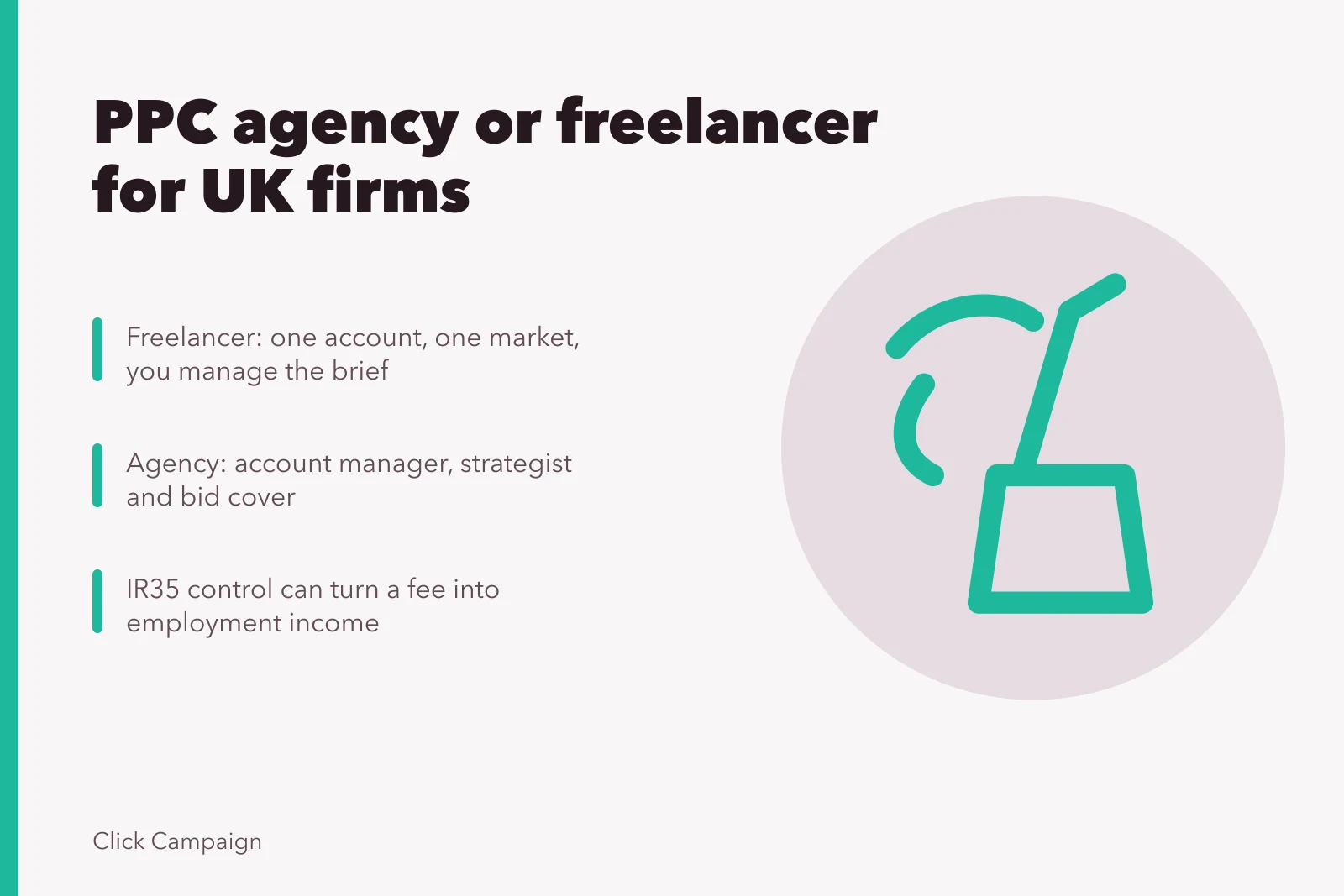
- A freelancer fits one account, one market and a brief you are happy to manage yourself.
- An agency fits accounts that need cover, several specialists and a named person under contract.
- IR35 often settles the argumentcontrol over how the work is done can turn a fee into employment income.
- Ask both for professional indemnity cover and a written data processing agreement before signing.
How the two models differ in practice
A freelancer sells time and judgement, not a team. You brief one person, keep the Google Ads account in your own name and decide the priorities yourself.
Freelancer vs agency at a glance
Freelancer
- Who does the work
- One practitioner
- Cover
- Limited
- Skill range
- Deep in one area
- Billing
- Hourly or retainer
- Insurance
- Often none
- Data protection
- Agreement may be missing
- Best fit
- One account, modest spend
Agency
- Who does the work
- Manager plus specialists
- Cover
- Built into retainer
- Skill range
- Search, shopping, creative, analytics
- Billing
- Retainer plus ad-spend fee
- Insurance
- Indemnity and liability
- Data protection
- Standard processing agreement
- Best fit
- Several markets, higher spend
An agency sells a process. You get an account manager, a strategist and someone watching bids when your main contact takes leave or falls ill.
The practical difference for a small business is cover. One person cannot run a busy account, take a holiday and answer an urgent query on the same afternoon.
Freelancer
- Who does the work
- One practitioner
- Cover
- Limited, holidays and illness expose you
- Skill range
- Deep in one area, thinner elsewhere
- Billing
- Hourly or a monthly retainer
- Insurance
- Often none
- Data protection
- Agreement may be missing
- Best fit
- One account, clear brief, modest spend
Agency
- Who does the work
- Account manager plus specialists
- Cover
- Built into the retainer
- Skill range
- Search, shopping, creative and analytics
- Billing
- Monthly retainer plus a fee on ad spend
- Insurance
- Professional indemnity and employer's liability
- Data protection
- Standard processing agreement
- Best fit
- Several markets, higher spend, reporting needs
If your monthly budget is modest, our guide to PPC agency options for small businesses sets out the models and what each tends to cost.
IR35 and off-payroll working
The off-payroll working rules, usually called IR35, apply when the client is a medium or large business. Small clients sit outside them, so the freelancer's own company decides the tax status.
Does IR35 apply to your engagement?
Is your client medium or large?
Off-payroll rules apply, client decides status
Small client, freelancer's company decides
Small has a legal meaning. The Companies Act 2006 sets the turnover, balance sheet and employee thresholds that decide it.
HMRC still examines the facts of the engagement. Supervision, direction and control carry weight, and so does a genuine right to send a substitute.
If you set the hours, supply the laptop and manage the freelancer like a member of staff, the arrangement looks like employment. On a small-client engagement that risk sits mainly with the freelancer's company, so the contract wording matters.
Insurance, contracts and who carries the risk
An established agency usually holds professional indemnity and employer's liability cover, and its filed accounts are public.
A freelancer may be a sole trader with no insurance at all. If a campaign error costs you sales, your recovery depends on the contract rather than on goodwill.
Check three things before signing: who is liable for mistakes, how much notice each side gives, and whether performance promises are written into the terms.
Agree a review rhythm as well. Our PPC agency audit checklist covers eight points to test each quarter, whoever runs the account.
Data protection and conversion tracking
PPC work involves personal data. Consent signals, conversion tracking and customer match lists all count.
The ICO's guide to data protection for organisations explains the controller and processor roles that a written agreement should set out.
Agencies normally have a data processing agreement ready to sign. A freelancer may not, and as controller you keep the legal responsibility either way.
Ad copy, claims and the CAP code
Ad copy is your responsibility as the advertiser, whoever writes it.
The ASA and CAP publish the advertising codes that cover misleading claims, prices and comparisons.
An agency with compliance habits flags a risky claim before it runs. A freelancer may not know the rules, so build the check into your approval process.
An illustrative worked example
The figures below are illustrative, not market averages.
Freelancer: £2,000 a month buys roughly 36 hours at £55 an hour. No VAT is added if they are below HMRC's £90,000 registration threshold, in force since 1 April 2024.
Agency: the same £2,000 a month might cover a named manager, a specialist team and holiday cover, with VAT added if the agency is registered.
You can usually reclaim that VAT if your own business is VAT-registered. On the freelancer route you may pay for tools and reporting yourself.
Common questions
Is a freelancer cheaper than a PPC agency?
Usually on the headline rate, yes, and no VAT is added if they are below the registration threshold. Agency fees also pay for project management and cover that a solo practitioner cannot provide.
Who is liable if the ad copy breaks the rules?
You are, as the advertiser paying for the ads. The codes apply to the business making the claim, not just to the person who wrote it.
Can I move from a freelancer to an agency later?
Yes. Keep account ownership, conversion tracking and historical data in your own name so a handover stays straightforward.
Do I need a written contract with a freelancer?
Yes. Set out scope, notice, liability and who owns the account and the creative.