Audience research
Part of Build a repeatable audience research method for UK paid search
How to build a PPC agencies target audience without guesswork
A practical method for building a PPC agencies target audience from official data, platform research and first-party signals, with a worked example in pounds.
What to take away
- A Manchester paid search team inherited a brief describing "SME owners" while its enquiry log showed finance directors at firms with 50 to 200 staff.
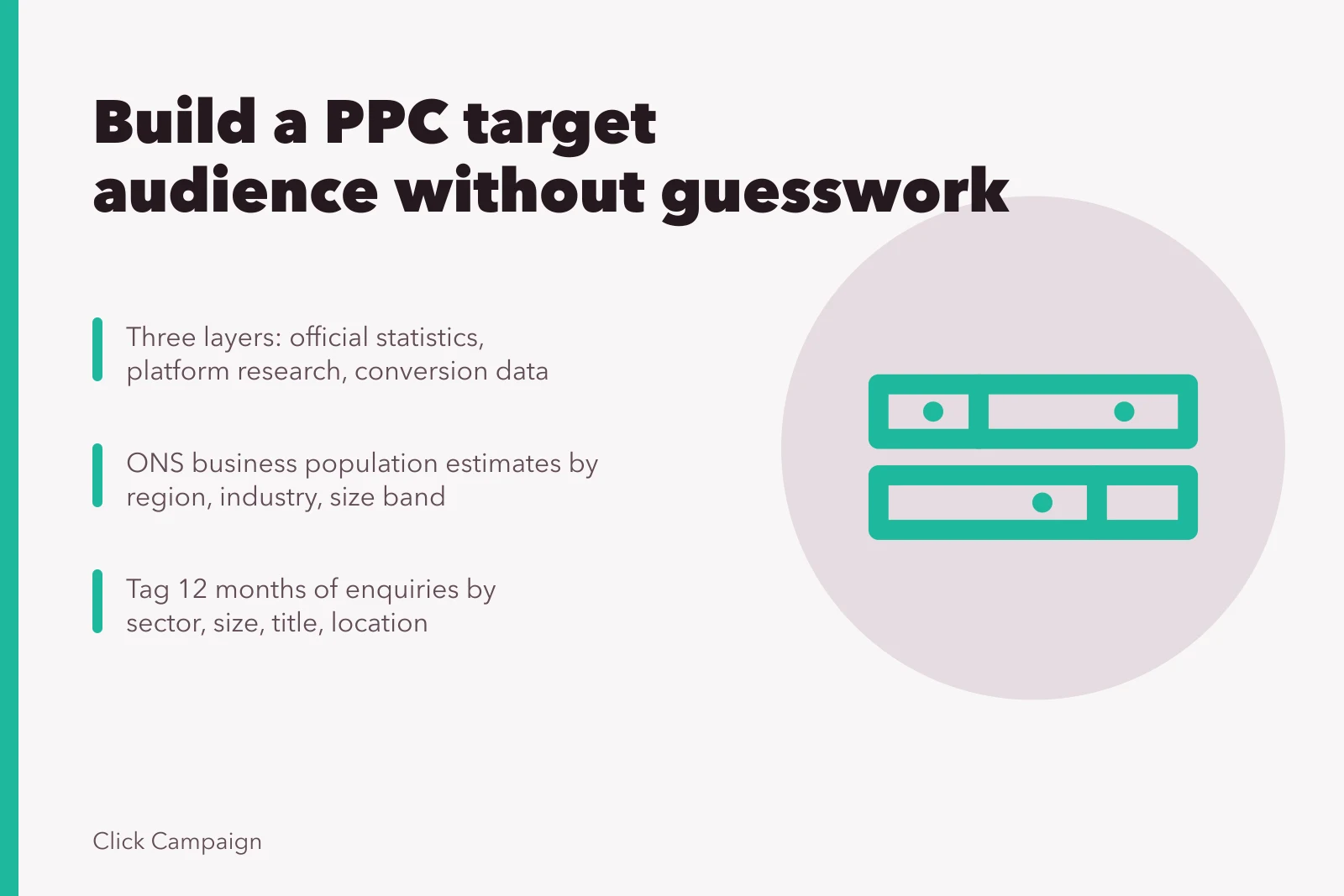
- Build the target audience in three layersofficial statistics for size, platform and industry research for behaviour, your conversion data for proof.
- Give every field a citable source so the definition survives a client challenge.
- Write it as one short statementsector, size band, role, geography, monthly budget.
- Review quarterly, because enquiry mixes move faster than published datasets.
Start with the question the client asked
Most briefs arrive as a phrase, not a dataset. "We want more leads from growing companies" is a starting point, not an audience.
Turn a brief into a measurable audience
- Start with the client's phrase
- Ask which job titles converted
- Ask which organisations converted
- Ask which locations converted
- Limit to the last twelve months
Turn it into something measurable: which job titles, at which organisations, in which locations, converted in the last twelve months?
The audience research guide for England sets out the research cycle this method sits inside, including how to brief stakeholders before pulling data.
Use official statistics for size and shape
Official data shows how many organisations of a given type exist and where they cluster. That stops a definition describing a market too small to fund a campaign.
The Office for National Statistics publishes business population estimates by region, industry and employment size band. Use them to check whether a sector holds enough firms in your size range to justify its own campaign.
Suppose a Leeds agency must reach marketing managers at firms with 10 to 49 employees in professional services across West Yorkshire. The estimates give no exact count for that combination, but they show whether the wider sector is big enough to test.
Add platform and industry research on behaviour
Size tells you who exists. Behaviour tells you who responds.
The targeting options described in LinkedIn's guidance on advertising to its professional audience cover job function, seniority, company size and industry. Those fields map onto a B2B paid search brief.
The Data & Marketing Association's research library covers data-driven marketing and customer acquisition, useful for benchmarking how other advertisers structure acquisition campaigns.
Standards evidence matters when the definition touches a claim. The ASA and CAP research pages publish evidence on advertising standards, worth checking before writing copy that promises performance.
Test the definition against your own conversion data
Published sources narrow the field. Your account data decides it.
Tag twelve months of enquiries with sector, organisation size, job title and location, then compare that mix with the audience you inherited. If the brief says "SME owners" but most enquiries come from finance directors at larger firms, rewrite the definition.
Budget follows the same logic. A team paying £400 a month for a broad match campaign may find a tighter audience at £250 a month produces more qualified enquiries. Cost per lead only improves if the qualification rate holds.
The competitor research in England method separates rivals chasing your audience from those chasing a different one. That avoids copying a targeting set built for someone else.
Write the audience statement
An audience statement is one short paragraph with numbers in it, specific enough to fail.
Use this format: sector, organisation size band, job role, geography, and the monthly budget the client will fund. For example: professional services firms with 10 to 49 employees in West Yorkshire, marketing managers, supported by a £600 monthly media budget.
Every field should trace to a source: sector and size to official statistics, role to platform targeting definitions, budget to the client's own figures.
Where no source exists, mark the field as an assumption and set a date to test it.
Common questions
How many data sources does a target audience need?
Three is usually enough: one official source for size, one platform or industry source for behaviour, your own conversion data for proof.
Can I build a target audience without first-party data?
Yes, but treat the result as a hypothesis. Set the opening definition from official statistics and platform research, then run a short test to generate the conversion data you lack.
How often should the definition be reviewed?
Quarterly suits most paid search accounts. Review sooner if the client changes sector, pricing or service area, since those changes alter who converts.
What if the client's brief contradicts the data?
Show both. Put the brief's definition beside the conversion mix, then recommend the version the evidence supports. The decision stays with the client.